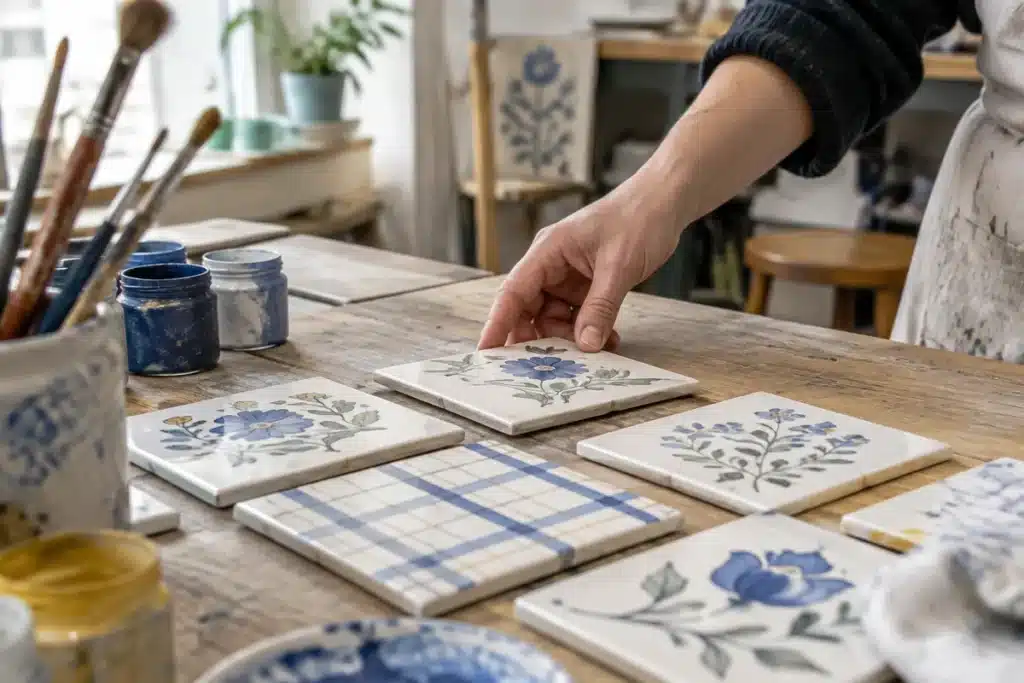
Plaids and floral motifs usually feel more suited to fabrics or wallpaper than to tile, but Fireclay Tile’s newest series argues otherwise. Named Idyllwild, this hand-painted lineup draws from classic textile motifs—translating everything from delicate botanical sketches to layered tartans into ceramic tiles that fuse nostalgia with a modern sensibility.
Surprisingly, the collection didn’t start with blooms. “We were noticing designers mixing lots of detailed textiles, colors, and patterns,” says Jamie Chappell, Fireclay Tile’s VP of Brand and Product, noting that the earliest concepts emphasized plaids and stripes. “As someone who loves ’90s alt‑rock, I briefly entertained the idea of making it a ‘grunge’ collection,” she adds.
That edgier idea softened over time. Because florals and plaids have long been paired in interiors, the design team brought botanical imagery into the mix to counterbalance the collection’s more structured motifs. The name Idyllwild was chosen in reference to the mountain community in California.
Why a Simple Mistake in Your Online Pension Application Could Cost You Your Retirement Benefits
The ultimate trick to banish mold from your bathroom grout in just 7 minutes—no vinegar or baking soda needed
Idyllwild is composed of 16 distinct patterns grouped into four families: Specimen Flowers, Idyllwild Florals, Idyllwild Stripes, and Idyllwild Plaids.
The Specimen Flowers set presents four standalone botanical tiles—Allium, Carnation, Lily, and Bluebell—intended to be arranged individually across backsplashes, inset niches, or as focal accents. The Idyllwild Florals use repeating patterns—Pomegranate, Tulip, Morning Glory, and Meadow—where overlapping stems, leaves, and petals produce a lush, layered look as if a garden has spilled beyond its edges.
The Stripes and Plaids explore a different decorative approach. The striped options—Stuga, Mokki, Blockhaus, and Thatch—create rhythmic movement with parallel lines and geometric touches. The Plaid series—Chalet, Highlands, Minka, and Torp—borrow the visual grammar of woven textiles, forming intersecting grids that can function as subtle texture or a strong, room‑defining statement.
Although the visuals reference fabrics, adapting those looks to hand-painted ceramic demanded a rethinking of pattern construction. “We needed to pare down and edit the artwork so our painters could actually hand-execute it,” Jamie explains.
The production technique relies on resist lines to separate color fields, which makes the sizing and spacing of each element crucial. “When we convert intricate woven patterns into screen art, we must be meticulous about line weight, the smallness of fill areas, and providing painters with natural pauses where they can easily start and stop,” Jamie says.
Fireclay’s painting crew was heavily involved during prototyping, flagging details that were too fine or spots where glazes wouldn’t lay smoothly. The company even formulated a new glaze base specifically suited to hand application.
Color and manufacturing were tightly linked in this project. Each pattern is offered in four curated palettes inspired by the seasons, but creating those options required a significant effort. Fireclay’s prior hand-painted swatchset had drifted away from its wider ceramic palette, limiting mix-and-match possibilities. To correct that, production spent months aligning the collection with the brand’s 50 core ceramic colors in both glossy and matte versions—yielding 100 compatible finishes to use across patterns.
To finalize the seasonal palettes, designers worked with actual tile samples alongside high-resolution 4K renderings, experimenting with combinations before converting choices into paint guides for production. The color narratives also reflect shifts the company has observed in interiors, including renewed interest in richer reds and grounded, earthy blues.
“Organizing the line into four seasonal suites really highlights how much color changes a pattern’s character: a plaid in pale pastels reads cottage-like and airy, while that identical weave in deep, moody tones feels like a heavy wool throw,” Jamie notes.
Idyllwild also introduces new tile sizes—2 x 8 inches and 3 x 6 inches—designed to coordinate with standard field tiles. Those proportions let designers apply patterns sparingly as trims or accents with stripes, or stretch more complex motifs across larger planes for a dramatic wall covering.
While the collection is rooted in familiar textile references, the final tile designs were shaped equally by the realities of hand-painting and production constraints as by source inspiration.
Editorial transparency: This piece was developed with the help of AI tools for tasks such as research, outlining, editing, or drafting. The Design Milk editorial team maintained responsibility for reporting, fact-checking, and the final editorial choices.
Similar Posts
- Innovative Ceramic UU Tiles by Unknown, Untitled: Dual-Function Hooks and Lamps!
- Trina Turk Unveils Vintage-Inspired FLOR Rugs: A Deep Dive into the Archives!
- Discover the Balera Collection: Where Lighting and Tiles Merge Beautifully!
- Revolutionizing Design: Osso & Bottone Transform Traditional Tile Grids with Playful Twists!
- Cersaie 2026 highlights six tile trends shaping design

Hi, I’m Michael from the Decatur Metro team. I offer you practical tips to enhance your living space.