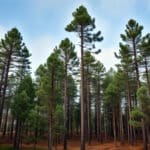
The birch tree, with its exceptional bark, has been a source of creativity, well-being, and survival for our ancestors for thousands of years. We explore how archaeologists today are replicating these myriad uses.
This article is published in partnership with .
Why the 12-5-30 Incline Walking Method Is the Ultimate Fat-Burning Workout, According to Fitness Experts
The ultimate trick to banish mold from your bathroom grout in just 7 minutes—no vinegar or baking soda needed
Ötztal Alps, a summer day 5,300 years ago. A man in his forties is crossing a pass at 3,000 meters above sea level. His brown hair whipped by the wind and his determined hazel eyes, he struggles across a glacier. A nascent fire accompanies him: in a birch bark box, smoldering embers wrapped in maple leaves smolder.
In his roe deer skin quiver, two arrowheads are securely fastened to their shafts with birch tar. This ancient adhesive also secures his precious copper axe, a relic of the late Neolithic period marking the beginning of a major technological and sociocultural shift in Europe—the advent of metallurgy. The man suddenly stops. A whistling sound splits the air. The arrow from his assassin fatally lodges in his shoulder.
Five millennia later, in the same region on the current Austrian-Italian border, two hikers unexpectedly encounter a corpse frozen in the ice. They have no idea they’ve just found Europe’s oldest mummy, nor that they’ve launched the career of a future global sensation. Ötzi is his name.
This archaeological wonder will be analyzed in detail over the following three decades. Among many findings, it is discovered that he carried two pieces of a medicinal fungus associated with birch trees. This fungus has healing and antiparasitic properties, particularly against the intestinal parasite that infested Ötzi. The Ice Man proves it: our relationship with the white tree dates back to time immemorial…
Franches-Montagnes (Swiss Jura), October 3, 2025. A man in his forties threads an elm fiber strap through birch bark using a bone awl. With his brown hair tied back and his determined hazel eyes, he meticulously crafts a cylindrical box. The ancient gesture is precise and swift.
Giovanni Foletti is an experimental archaeologist. He reconstructs various artifacts found in prehistoric digs, attempting to replicate ancient manufacturing techniques through experimentation and analysis of remains. This manual enthusiast is not new to crafting boxes. One of them, 20 cm tall, stitched with linden bast, resembles Ötzi’s model.
« Since eyed needles are rare in the Neolithic, and since Ötzi had a bone awl, I use this tool to pierce the bark, even though it takes five times longer », the craftsman mutters, sitting cross-legged amid a carpet of heather in autumn hues.
The handling of this flexible yet brittle material requires delicacy and skill, like the hazel hoop he inserts to prevent the stitches from splitting the work. The quality of the material also depends on the age or the environment where the tree grew: the archaeologist mainly harvests Betula pendula, the most common, but he especially praises the varieties that grew in Northern Europe.
Why did our ancestors choose to work with birch bark? « For its aesthetics, lightness, and the fact that it’s strong and decay-resistant! » summarizes the melodious voice of Lara Driscoll, Giovanni Foletti’s partner. Her chestnut curls frame her mischievous eyes, a ceramist passionate about ancient pottery. Archaeological remains reveal a pervasive use of birch bark among indigenous peoples of boreal regions.
Waterproof, it covered numerous shelters like the Sami huts and the teepees and wigwams of Native Americans. These people also used it for their lightweight canoes, suitable for rapid waters. Russian peoples sewed clothing and shoes from it. The birch tree bark also illuminated the night landscape as torches soaked in resin.
This papyraceous material even held ancient sacred Sanskrit texts, as well as millennia-old writings found in Russia—love letters, business deeds, reminders, and peace treaties. Also mentioned are pebbles wrapped in bark used as weights for fishing nets, found with the Palafittes by Lake Neuchâtel, and the büchel, a Swiss musical horn made of spruce circled with birch skin.
Yet, there is an even more surprising use. Lara rotates in her hands a black pot adorned with an ivory-colored zigzag pattern. « This decor is mesmerizing, with its very exotic looks », exclaims Giovanni. Up close, one can recognize the birch bark.
The ceramist has created a series of these specific Neolithic Swiss potteries. The remains, from the first half of the 4th millennium BCE, were found in lakeside sites in Romandy and the Combe d’Ain (French Jura). Only peat bogs and lake sediments could have preserved the plant materials.
The artisan was inspired by publications and digs: « I collected clay near a stream. I mixed in a crystalline degreaser, crushed granite, and quartz, to give a skeleton to the pieces and make the potteries resistant to thermal shocks. »
After shaping and drying, she conducted a wood fire cooking in an oxygen-deprived environment for the black color. Then came the cutting of the white bark using a flint scalpel. « The ancestor of paper cutting? » Lara jokes in reference to .
The reconstructors had to collaborate for the laborious task of gluing the decorations. Clearly, these fine potteries, which cannot be placed on fire nor withstand dishwashing, served a special function. Festive dishes, wedding gifts, ritual objects? Mystery remains.
Speaking of glue, how did our ancestors manage without instant extra-strong gel? Demonstration! In the center of the garden, the preheated hearth now hosts a small clay pot topped with a large perforated lid. The couple of artisans stuff strips of birch bark into a clay jar crafted by Lara, turn it over, and wedge it on the lid which acts as a funnel.
Around this giant egg, a nest of twigs is built. The next actor enters the stage: the fire. « It will require a slow temperature rise by gradually feeding it wood, to avoid any thermal shock, followed by a big final blaze », explains Giovanni.
He throws into the hearth white bark scraps that instantly ignite, emitting acrid black smoke: « It’s very handy to have in your fire-starting kit, it even works when wet. » Thanks to its content of highly flammable betulin, this material likely saved the lives of more than one prehistoric human. The dancing flames begin to lick the pottery within which magic happens. Before discovering the result, a quick tour towards a birch paradise.
« A little corner of Canada! » Giovanni exclaims in front of the Hell’s Bog. Among hundreds of young birches and heather bushes, a thick mattress of sphagnum moss embroidered with fine cranberry stems spreads out. At the heart of this jewel, a pond filled with invites introspection.
Why choose the path of experimental archaeology? « It feels good, says Giovanni. I believe these are important gestures, ingrained in our manual animal genes. A large part of our brain is dedicated to our hands. »
Lara adds: « Knowing the resources of your environment and keeping your hands busy gives a deep sense of tranquility, autonomy, and thus freedom. Imagining how our ancestors lived based on objects miraculously preserved connects us to them. »
When asked about their relationship with nature, those who were happy wildlings in their childhood refer to . « This word, it’s what separates us from the rest, specifies Giovanni. Every plant, stone, animal is a person with its own reality and way to express itself. Even though it doesn’t kill them, I prefer to harvest bark from dead birches, or else I ask and give thanks. »
The young woman specifies: « We work with all kingdoms: plant, mineral, animal… It puts humans back in the circle of life, not outside it. » This animistic vision is also that of many root peoples who inspire them so much.
Back to the extinguished hearth. The experimenters lift the large jar. « Wooow! » In the still-smoking crucible, a pool of ink-black tar has formed: the pitch. It’s clear why the birch—Betu in Gaulish—gave its name to bitumen, but the relationship with the asphalt of our streets remains semantic.
« It’s still mysterious, the black extracted from the white », muses Lara. More prosaically, it’s pyrolysis: through heat and in the absence of oxygen in the ceramic chamber, the light barks have partially liquefied into aromatic tar. Giovanni grabs the pot of glue and adds an equal part of resin, which acts as a hardener.
Under a soothing sunbeam, accompanied by the gentle song of bullfinches, he applies the viscous mass with a stick to a flint arrowhead he has tied to a wooden shaft. In addition to fitting tools, this tar was also used to repair broken pottery.
For the two artisans, this mixture has « the smell of Prehistory ». In 2023, research showed that the manufacture of birch tar began with Neanderthals 200,000 years ago… long before Ötzi.
Some archaeologists suggest that this material—apparently as adhesive as modern two-component glues—is the oldest synthetic substance ever made by a hominid. A process that requires advanced cognitive abilities, previously thought to be the exclusive domain of Sapiens…
| La Salamandre, . |
legend
Similar Posts
- Discover Birch Bark Wonders: From Glue to Clothes, Explore Its Thousand Uses!
- Discovering the Rosalia Alpina: Unveiling the Hidden Jewel of the Forests
- Devastating Fire in Drôme: A Lament for Lost Natural Heritage and Wildlife
- The surprising reason gardeners swear by painting tree trunks white
- Mountain Owls Mystery Unveiled: Tracking the Elusive Night Raptors in the Alps

Hi, I’m Ashley from the Decatur Metro team. I share essential information for a sustainable and responsible lifestyle.