What if we relied on the voracious appetite of dragonflies to combat mosquito larvae? A town on the Basque coast has embraced an association’s proposal: to create ponds as refuges for biodiversity and small natural enclaves within the city.
Bidart (Pyrénées-Atlantiques), reportage
Why the 12-5-30 Incline Walking Method Is the Ultimate Fat-Burning Workout, According to Fitness Experts
The ultimate trick to banish mold from your bathroom grout in just 7 minutes—no vinegar or baking soda needed
Near the parking lot of Bidart’s school on the Basque coast, a high-pitched whistle emanates from a lawn. Is it a bird’s call? “It’s a midwife toad,” clarifies Charlotte Mulet, a project manager at the Bio Divers Cité association. “It’s listed as endangered, but it’s quite common in the Basque Country.” The reason for its croaking close to the elementary school benches is a pond installed right in the city center, adjacent to the parking area.
This initiative is part of the association’s commitment to reintroduce nature and living ecosystems into urban areas. One of Charlotte Mulet’s key campaigns is to change the negative perception of ponds; they are mistakenly seen as mosquito breeding grounds, leading many towns to drain and destroy them. Urban water bodies have significantly decreased, especially since the arrival of an unwelcome guest in mainland France: the tiger mosquito.
François Meurgey, an entomologist at the Museum of Natural History in Nantes, points out that this tropical insect has thrived due to human activities: “Our behavior provides perfect conditions for it to settle.” Climate change and global trade have facilitated its spread, while urban areas offer ideal conditions for its proliferation. According to the expert, an epidemic outbreak by 2030 is “more than likely.”
The number of cases of diseases transmitted by the tiger mosquito (chikungunya, dengue, and Zika) continues to rise annually in mainland France. For instance, indigenous cases of chikungunya were detected for the first time in Nouvelle-Aquitaine in the summer of 2025.
In this context, addressing mosquito breeding sites is a public health priority. The first step is to eliminate potential larval habitats by emptying watering cans, cleaning gutters, and even “the cat’s bowl,” emphasizes François Meurgey, who conducts outreach to educate residents about these health measures.
He also highlights the design of certain new buildings with terraced plots, which are perfect breeding grounds for mosquitoes. “We need to rethink our construction methods,” he adds.
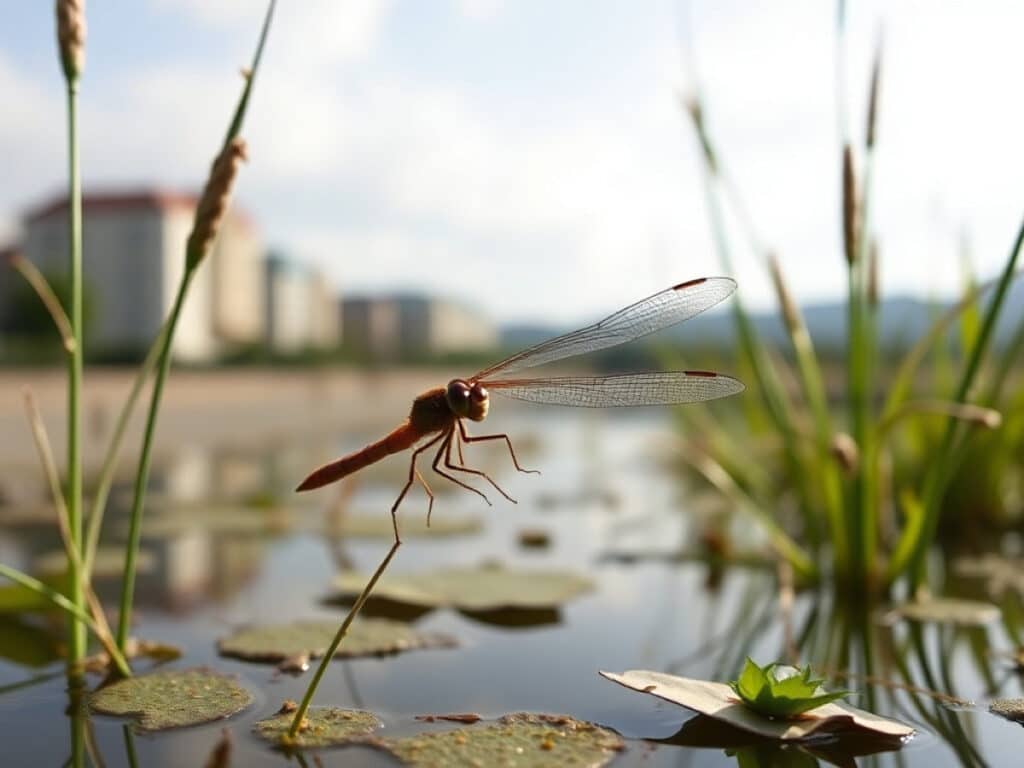
Are all water bodies undesirable? No, counters Charlotte Mulet. In the ponds created by her association, gentle slopes and vegetation are installed. As a result, a balanced ecosystem develops, including mosquito predators. “Here, dragonflies showed up within three weeks,” she notes, retrieving a somewhat sluggish dragonfly larva from the cold water. Known as “dragonflies” in English, these carnivorous insects’ larvae devour mosquito larvae, while the adults can consume up to a hundred dipterans a day.
These ponds not only attract dragonflies but also other predators. Among the plants covering part of the water body, a small cluster of pearly eggs floats—a suitable breeding spot for amphibians like the midwife toad, which might be hiding nearby in the grass.
A little further, tadpoles cling to the pond’s muddy bottom. Amphibians, which include mosquitoes in their diet, also thrive here. The pond also serves as a watering hole for insectivorous birds such as swallows and swifts. “Last summer, when we visited, there were no mosquitoes,” Charlotte Mulet excitedly reports. She is convinced these small water bodies reintroduce predators into urban settings and help control the spread of biting insects.
“Proper construction and maintenance are crucial because a self-sustaining pond doesn’t exist. Dragonflies demand higher water quality than mosquitoes,” warns François Meurgey. Charlotte ensures ongoing maintenance in Bidart. The town, one of the few to embrace such a project, provides Bio Divers Cité with resources for a few hours of work on-site: “We dredge the pond by thirds. Each year, we refurbish a section to keep it water-filled,” explains Charlotte.
For the entomologist, ponds are not just about the number of mosquitoes consumed by resident species; they also offer scenic, educational benefits and enhance biodiversity. Ideally, they should be paired with nesting boxes. He also advocates for ecological monitoring to assess the impact of these features.
While awaiting potential impacts on mosquito populations, Charlotte Mulet enjoys positive feedback from the community. The small water bodies created by her association serve as educational tools to reconnect urban dwellers with biodiversity. “Last year, we hosted children from a Biarritz leisure center on our site,” she recounts. “They watched the dragonflies and came to me every thirty seconds, excitedly reporting: ‘it changed color!’ ‘it left its skin on the leaf!’”
Tasked with counting dragonflies, the children collected exuviae, the shed skin left by the insect during molting. “Thanks to their counting, we know that one of our ponds can host several hundred dragonflies,” she says, showing a jar filled with molts collected by the kids.
“A single pond won’t make much difference because mosquitoes reproduce at a much higher rate than their predators,” cautions François Meurgey. To achieve significant results, such initiatives need to be multiplied, involving both communities and individuals.
On the Basque coast, Bio Divers Cité is forming a group of volunteers interested in creating ponds in their gardens to train them. The goal is to explain the process, common mistakes to avoid, and the maintenance needed to keep the ponds ecologically healthy. Then, it’s up to each individual, as the small organization, with only three employees and a few civic service volunteers, doesn’t have the resources to monitor dozens of ponds.
This initiative aimed at individuals also seeks to restore “blue corridors” in cities, similar to “green corridors,” ensuring ecological continuity between aquatic environments often compromised in urban settings.
It’s a way to support the return of richer ecosystems in cities with a host of allied species so that humans are “not left alone to face the mosquitoes,” concludes the project manager.
The continuation of our report in photos:
Similar Posts
- Mountain Volunteers Revive Drying Ponds: Swift Nature Recovery After Drought
- Nature’s Quick Comeback: Volunteers Revive Dried Mountain Ponds After Drought
- “I haven’t seen a single mosquito since putting this plant on my terrace”—But is citronella really the safest choice for your summer? Environmental experts warn of unexpected risks
- A new jellyfish species with 24 eyes has just been discovered in Hong Kong
- How Do Migratory Birds Tackle Drought? Naturalists Explore by Canoe

Hi, I’m Ashley from the Decatur Metro team. I share essential information for a sustainable and responsible lifestyle.