How can we slow down the melting of glaciers, a process that seems inevitable? While halting carbon emissions is crucial, discussions are also emerging about the status of glaciers as communities debate the policy of relying solely on skiing.
Bourg-Saint-Maurice (Savoie), report
Why the 12-5-30 Incline Walking Method Is the Ultimate Fat-Burning Workout, According to Fitness Experts
The ultimate trick to banish mold from your bathroom grout in just 7 minutes—no vinegar or baking soda needed
About twenty children take the stage, holding a statement in their hands, from which they read lines one by one. “Hey humans, instead of making us melt, won’t you help us?” says one student. They are members of the children’s municipal council of Bourg-Saint-Maurice, concluding the festival with a question that has captivated scientists, NGOs, elected officials, professionals, and locals: how can we protect glaciers from complete disappearance?
The situation is critical. In 1950, at the end of the Little Ice Age, there were 927 glaciers in the Alps covering an area of 616 km². By 2022, only 503 glaciers remained, covering 212 km², according to a study by Ice&Life.
To delay the inevitable, it is vital to urgently reduce our greenhouse gas emissions, as Jean-Baptiste Bosson, a glaciologist and the festival organizer, points out. “1 g of CO2 emitted melts 16 g of ice,” he specifies. While waiting for a national political strategy that adheres to the Paris Agreement, several local initiatives have sprung up, such as in Bourg-Saint-Maurice.
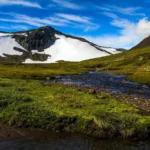
The town boasts three glaciers, including the Varet, located in the Les Arcs ski area. At an altitude of 3,226 meters, it is the highest point of the resort. It once delighted skiers with a 7 km descent from its summit.
Since the 1850s, the Varet glacier has lost 90% of its surface and continues to melt at a rate of 2 to 3 meters per year. Its slope has become so steep that only experienced athletes can now navigate it.
Instead of stubbornly making it usable by employing bulldozers and snow groomers, the community of Bourg-Saint-Maurice and the Les Arcs resort have decided to eventually close this ski run. “We hosted two evenings to share scientific data about the glacier’s condition with the locals and professionals. When we told them it had between 10 to 15 years left, we were able to reach a consensus on a very divisive issue,” explains Guillaume Desrues, the mayor of Bourg-Saint-Maurice.
He now hopes to go even further and establish a protective status for the Varet and other glaciers in the area. “Over the next six months, we will work with residents and mountain professionals to define the scope and level of protection for this zone. We are writing the future for these giants so that children born today may still have the chance to touch them.”
However, there are no plans to close the Aiguille Rouge cable car, which accesses the Varet and is used by 400,000 people annually. Instead, the community is considering setting up an educational observatory. “This is an opportunity to raise awareness about this fragile territory and the importance of protecting these environments,” continues Guillaume Desrues.
He is not the only one trying to shift away from the ski-at-all-costs policy. Thirty kilometers away, the Tignes resort is also considering the future of its glaciers, especially the Grande Motte. This iconic location, featured in the resort’s logo, was long the promise of skiing 365 days a year. “I grew up believing in eternal snows and that we could always ski there. It’s hard to accept that it won’t last,” says Olivier Duch, deputy mayor of Tignes.
Yet, climate change is wreaking havoc here as elsewhere. The Grande Motte has lost a third of its surface and two-thirds of its volume between 1982 and 2019. As a result, the ski season is shrinking each year: from November 23, 2024, to May 4, 2025, last winter.
Eventually, Tignes will also cease skiing on the glacier. “We are not going to persist. We will not overwork the snow groomers or break up snowdrifts to bring in snow,” assures Olivier Duch. The 4 km² area should be sanctified. “We are working on a project to requalify this space by creating a contemplative and educational project to raise awareness about climate warming,” he adds.
These local initiatives can serve as examples at the national level. However, they will need to be supported by legal tools and dedicated budgets, as Arnaud Gauffier, the director of the Savoie natural spaces conservatory, reminds us. “There are plenty of protection statuses in France. The goal now is to have the financial means to manage, protect, and study them with scientists.”
However, with the reduction in funds allocated to ecology and attacks against the work of the French Office for Biodiversity, these goals will be hard to achieve.
Currently, 62% of glaciers are under strong protection (within national parks or nature reserves, for example). For others, like the Girose glacier, various legal tools could be utilized.
Philippe Billet, a professor of public law at the University of Lyon and director of the Institute of Environmental Law, listed several during the festival. He suggests leveraging European law, with directives like Natura 2000 or the regulation on nature restoration, or French law, such as the ecological continuity regimes, nature reserves, or real environmental obligations.
Marine Yzquierdo, a lawyer with Our Affair to All, discussed rights of nature as in India, where glaciers have had legal personality since 2017.
Legislating at the international level is the dream of Jean-Baptiste Bosson. The glaciologist proposes that France lead the way by presenting, at the next World Congress on Nature in October 2025, the first international motion on the protection of glacial systems and postglacial ecosystems.
“The territories that these ice giants, once gone, will reveal are already targeted by industry. By protecting these areas, we protect the nature that will emerge from glacier retreat,” hopes Jean-Baptiste Bosson.
Preserving glaciers is not just about pleasing a select group of experienced climbers. It’s primarily about protecting our water towers, whose disappearance could completely disrupt the water cycle in our country. “Today, snowmelt occurs earlier in the year. Therefore, we have more flow in winter. In the long term, this will pose a problem for the amount of water in the rivers,” explains Olivier Champagne, a researcher at the National Institute for Agricultural Research.
In addition, thanks to their bright surfaces reflecting sunlight — a phenomenon known as albedo — glaciers play a crucial role in climate regulation. Once melted, they leave behind dark soil that accelerates global warming.
To accelerate this awareness, the UN has declared 2025 as the International Year of Glacier Preservation. A first step, believes Jean-Baptiste Bosson. “Glaciers are something that amazes and brings people together. We must show that acting for the common good can restore joy.”
Receive daily, free of charge, all the news about ecology directly in your mailbox.
Subscribe
Similar Posts
- Pulp, Black Country, New Road Headline 2025 La Route du Rock: Full Lineup Revealed!
- We Love Green 2025: Vald and Sampha Added to Star-Studded Lineup!
- Philippe Katerine & Kompromat Headline Minuit avant la Nuit 2025: Full Festival Lineup Revealed!
- Peter Doherty Headlines: Unveiling the Stellar Lineup at the Transe Atlantique Festival!
- Mountain Volunteers Revive Drying Ponds: Swift Nature Recovery After Drought

Hi, I’m Ashley from the Decatur Metro team. I share essential information for a sustainable and responsible lifestyle.