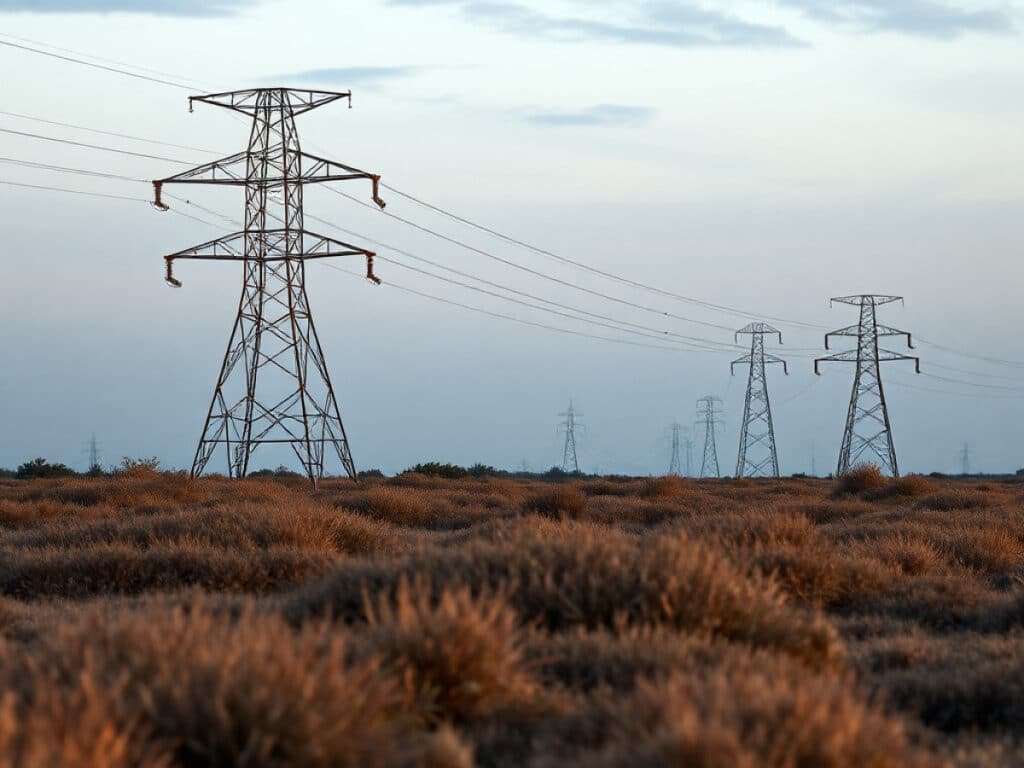
How will the electricity aimed at decarbonizing the Fos-sur-Mer industrial area be transported? The state and RTE favor an overhead line for its quicker construction and lower cost, despite opposition from locals and environmentalists.
The decision has been made: towers will cross the sensitive areas of Camargue and Crau, ignoring alternative scenarios that are less harmful to biodiversity. This new ultra-high voltage line — 400,000 volts — running from Jonquières-Saint-Vincent (Gard) to Fos-sur-Mer (Bouches-du-Rhône) is intended to meet the future electric needs for the “decarbonization” and reindustrialization of the industrial and port zone.
Why the 12-5-30 Incline Walking Method Is the Ultimate Fat-Burning Workout, According to Fitness Experts
The ultimate trick to banish mold from your bathroom grout in just 7 minutes—no vinegar or baking soda needed
This is a significant issue: the factories in the Gulf of Fos currently account for 25% of the national industrial greenhouse gas emissions.
According to the state’s plans, published on December 18 following a public debate, a 65-kilometer electric line will be erected by 2030. It will pass through the Regional Natural Park of Camargue, the natural reserve of Coussouls de Crau, and four Natura 2000 sites.
The Crau plain, the last dry steppe of Western Europe, would be particularly affected. The habitats of several species, especially birds, would be threatened. The lesser kestrel, a bird about thirty centimeters long, could even face extinction in France, it has been warned.
Underwater or underground solutions were brought up during the public consultation that took place from April to July 2025. A collective of about thirty associations, THT 13/30, suggested an infrastructure composed of two lines: one submarine across the Gulf of Lion from Aude and the other buried or along the Rhône riverbed.
The state’s report, however, considers that the alternative proposed by the THT 13/30 collective is technically complex and raises many uncertainties. Jean-Laurent Lucchesi, spokesperson for the collective 13/30, calls this argument “deceptive.”
“We haven’t invented anything new. We are only proposing techniques already used by RTE,” he says, noting that similar arrangements have been implemented in the Gulf of Gascogne.
Nevertheless, according to the state, opting for a submarine route would involve significantly higher costs and uncertain delays. This solution would be operational by 2035 at an estimated cost of 4 billion euros — while the aerial version would cost between 300 and 400 million euros.
The decision pleases the Provence fabrique des possibles lobby, which includes over a hundred industrialists. The state plans to activate the new aerial electric line by 2029. “It’s all about speed for purely financial reasons,” criticizes Jean-Laurent Lucchesi, “and for the data centers planned around Marseille,” the sixth largest global data traffic hub.
Two other scenarios suggested by an independent expert appointed by the prefect of Bouches-du-Rhône considered either burying the entire 65-kilometer line or doing so partially. These are not prioritized by the state due to longer service times and higher costs than the aerial option.
The partially buried line would only be ready between 2031 and 2034 for an additional 100,000 euros. A fully buried line, however, would not be operational before 2035, at a cost at least 10 times higher than the aerial line — up to 3.6 billion euros.
“We will not let our territories and their rural and tourist economies be sacrificed. We will fight this legally,” asserts Jean-Laurent Lucchesi. “We are not against industry; we advocate for a real territorial project.”
Facing opposition pressure, including ecologists, farmers, and local politicians from the affected areas, the new prefect of Bouches-du-Rhône, Jacques Witkowski, is already cautious. He announced that the public interest declaration for the infrastructure would be made after the municipal elections on March 15 and 22, 2026.
“We have asked RTE to continue its studies. We would take a significant legal risk if we did not further explore an alternative to the all-aerial approach,” he stated. “It gives us a bit of time to prepare,” Jean-Laurent Lucchesi is satisfied, who also promises dramatic actions.
Similar Posts
- Endangered Bird Faces Extinction: High-Voltage Power Line Threatens Rare Ganga Cata
- A 2,500 km EV Road Trip Proves Diesel Still Reigns Supreme
- In Rouen, 90,000 Residents Battle Against Polluted Water Supplies
- Why Hybrid Cars May Not Be the Eco-Friendly Bargain You Expect
- Gas Cars Last 12 Years—Electric Vehicles Get Replaced Every 3, Study Finds

Hi, I’m Ashley from the Decatur Metro team. I share essential information for a sustainable and responsible lifestyle.