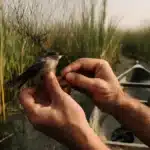
Two wind farm operators in Hérault have been found guilty of causing the deaths of protected birds of prey. These rulings come amid a backdrop of declining species protection.
A significant judicial reprimand occurred recently: the Montpellier district court imposed strict fines and sentences on two major French energy companies and ordered the temporary shutdown, from four to twelve months, of nearly forty wind turbines—effective immediately—following the deaths of protected raptors.
Why the 12-5-30 Incline Walking Method Is the Ultimate Fat-Burning Workout, According to Fitness Experts
The ultimate trick to banish mold from your bathroom grout in just 7 minutes—no vinegar or baking soda needed
In the first instance, numerous lesser kestrels were killed by the wind turbines of EDF Renewables at the Causse d’Aumelas, northwest of Montpellier. The company and its subsidiaries were fined over 5 million euros on April 7, half of which was suspended. Bruno Bensasson, the former head of the company, was given a six-month suspended prison sentence.
On April 9, ERL, a subsidiary of the Valeco group, was fined 200,000 euros, half of which was suspended, after a golden eagle was struck by a wind turbine blade in 2020 at their Bernagues wind farm, 50 kilometers from Aumelas. Both Valeco and EDF Renewables have declared their intention to appeal these verdicts.
The courts have taken such actions against these energy companies possibly because these wind turbines should not have been built in such sensitive areas. “At Bernagues, they were warned ten years ago about the risk of collisions with golden eagles nesting nearby, which carried legal risks,” notes Simon Popy, president of France Nature Environnement Occitanie-Méditerranée, a civil party in both cases.
The same was true at Aumelas, where, right from the early years of operation, dead lesser kestrels were found near the turbines. Despite these risks, operations continued fully or partially without authorities taking measures to completely halt the fatalities. Over time, through multiple legal appeals, convictions were secured.
“The Council of State ruled in 2022 that the risk to even a single individual of a protected species requires a project bearer to file for an exemption,” explains Arnaud Gossement, a lawyer specializing in environmental law and defender of wind energy companies. The law fundamentally prohibits the destruction of protected species, but prefects may grant exemptions on a case-by-case basis. “Previously, some administrations only required such filings when a population, not just an individual, was affected,” Gossement elaborates.
That same year, the Court of Cassation ruled that the crime of destroying protected species occurs when the park operator has not filed for a destruction permit and even a single individual has been killed. For the lawyer, “this strict evolution in jurisprudence comes as political support for wind energy in the name of environmental protection was waning.”
“But the destruction of species isn’t quantifiable by weight! It’s a qualitative issue. We should see each royal eagle as a miniature Mona Lisa,” says Cédric Marteau, Director General of the League for the Protection of Birds, referring to the dead bird which was a breeding male of a highly vulnerable species with very few offspring in its lifetime.
For the NGO leader, the goal is thus to end these harms: “We still see projects like the wind farm at sea in Dunkerque, planned right in the middle of Europe’s primary migratory corridor.” In such areas, “no matter how many risk mitigation mechanisms you put in place, it will never be sufficient given the impact,” he asserts.
Pleased with the rulings, Simon Popy mainly hopes for “a change in attitude” from renewable energy companies, “to stop disregarding environmental NGOs” on this matter. However, he worries about the “undermining work” being conducted by politicians from the center to the far right, who are attacking the very laws protecting species. In February, the agricultural orientation law proposed a presumption of “non-intentionality” of species destruction, which was ultimately overturned by the Constitutional Council.
Now, the Economic Life Simplification Law, currently under review in the National Assembly, could further ease the process of obtaining exemptions for the destruction of protected species for all renewable energy projects. And uncertainty remains over how France will implement new European directives promoting renewable energies, which could lead to further relaxations in species protection.
Similar Posts
- Eagle Killed by Wind Turbines: New Law Clears Company of Blame
- “Wind turbines nearby slashed my home’s value”—the controversy every homeowner is talking about
- Eco-Destructive Projects: Endangered Species Protection at Risk
- Trump Claims Destroying Habitat Does Not Harm Species: Environmental Controversy Explodes
- Australia’s Wildlife Vanishes: Politicians Turn a Blind Eye

Hi, I’m Ashley from the Decatur Metro team. I share essential information for a sustainable and responsible lifestyle.