The rare and stunning Venus slipper orchid blooms through a mysterious process in fiercely protected locations. Let us tread along a Jura mountainside to encounter this legendary orchid with expert Olivia Rusconi.
This article is published in partnership with
Why the 12-5-30 Incline Walking Method Is the Ultimate Fat-Burning Workout, According to Fitness Experts
The ultimate trick to banish mold from your bathroom grout in just 7 minutes—no vinegar or baking soda needed
Val-de-Travers (Switzerland), report
The day of the summer solstice begins on the wrong foot. The morning’s dire weather forecast delayed the botanical excursion by a few hours. However, the heavy black clouds only rolled in during the afternoon at the gates of the Jura massif, as we finally set out. Tricky weather indeed. As we walk through Val-de-Travers, large raindrops pelt the ground.
« The Venus slipper [i>Cypripedium calceolus] usually blooms in April-May at the secretive location we’re visiting. But this cold, rainy spring has shifted the schedule. These flowers can bloom for two weeks or just two days, and they don’t fare well in rain… », Olivia Rusconi had shared over the phone. Now a scientific collaborator for the State of Neuchâtel (Switzerland), she has spent six years studying this plant that many dream of seeing at least once in their lifetime.
Our path zigzags through a lush forest with a tropical dampness. The smooth trunks of beech trees, planted like elephant legs on a moss carpet, drip with moisture. In such a setting, it’s easy to imagine encountering the exotically beautiful flower in a splendid moment. « The Venus slipper is to plants what the panda is to mammals, explains the young botanist. It’s a heritage plant that has become rare and is well-known to the public. There’s even an emotional connection, which helps raise funds for its conservation. It’s an umbrella species: by saving it, we protect a whole host of organisms that share its habitat. »
Continuing her master’s work, which aimed at identifying suitable reintroduction sites for the species, Olivia Rusconi completed a PhD in 2023 at the functional ecology lab at the University of Neuchâtel. Her goal ? To develop a methodology that merges fundamental research with a practical approach to conserving endangered plants. The Venus slipper presents an ideal case study: numerous reintroduction attempts have been made, but with limited success. Despite its fame, the plant remains poorly understood.
The biologist has tirelessly worked to determine the factors that affect population vigor. She conducted spatial modeling based on existing botanical surveys, correlating them with various variables such as temperature or distance to the forest edge. This theoretical analysis was accompanied by a more naturalistic field approach. « Even with fine 25 m grids, maps are not enough. A reintroduction can succeed or fail by mere meters, especially since the soil is very heterogeneous », reveals the researcher.
Choosing an orchid as a model also means dealing with an organism that has very complex requirements in terms of soil, climate, and relationships with other species. « If we can protect the Venus slipper, we can protect everything », asserts the doctoral student playfully.
We veer off the beaten track to climb a sparse meadow dotted with fly orchids and young spruces shimmering with droplets. A chiffchaff calls, marking the end of the rain shower. The sloping ground has turned into a slide. How ironic that I wore my hiking sandals to search for slippers… « This species often settles in rugged terrains like scree or disturbed riparian zones, shares Olivia Rusconi. But over time, it seems to require a more stable open forest environment. This habitat is tending to disappear with the closing of forests. »
A sign stands alone in the middle of nowhere. It reminds us of the prohibition against picking or uprooting the iconic orchid. Ah, here we are ! « Among the factors for its rarity, it has historically been over-collected. Illegal harvesting continues even today… In 2017, in a nearby French reserve, an entire population was uprooted overnight. It’s tragic because with habitat fragmentation, each population is a crucial link in the chain », laments the specialist.
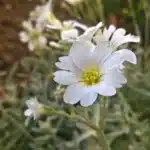
Distracted by the sign, I hadn’t noticed the magnificent creatures growing at its base. A barely perceptible breeze stirs the flowers perched on top of long green stems. These fairy-like beings sport four cross-shaped brown-purple wings and a striking yellow, bulbous slipper.
The enthusiast pulls out a small metal ruler and gently picks up a leaf. « My research sometimes took on an old school vibe. I traveled across Switzerland, from Romandy to the Grisons, through Aargau and Ticino, to examine Venus slippers. I chose non-invasive measures to assess their vigor: size and number of leaves, number of stems, flowers, photosynthetic activity… » This marathon also included assessing the living environment, notably with an inventory of surrounding vegetation to understand the plant community reference.
« One key finding was that the Venus slipper grows quite close to the forest edge and needs large trees nearby, ideally between 20 and 50 m tall, so their canopies act as umbrellas, yet the environment remains very clear. Both undergrowth, forestry, and grazing are detrimental to it. That’s where we see how delicate the balances are in nature », summarizes the young woman.
The beautiful plant grows like horticultural clumps. « All this clump is a single individual ! exclaims Olivia Rusconi, pointing at a tuft. It reproduces vegetatively through its rhizomes. » To maintain a vigorous lineage through genetic renewal, Aphrodite’s shoe also engages in sexual reproduction. So, how does this plant named after the goddess of Love manage ?
« It attracts pollinating insects with the yellow color of its large labellum and its scent, explains my guide. I’ve bagged flowers in oven bags, then pumped out the accumulated scent molecules for analysis. The mix, including linalool and octyl acetate, probably gives the illusion of tempting nectar. » Yes, because the flower actually offers no sweet reward to the insects. Let’s follow a wild bee that eagerly dives into a slipper.
So, where’s the expected nectar ? A few turns on itself, and it becomes clear: the smooth chamber is just a beautiful deception. To escape ! But with the entrance curving inward, the insect can’t fly straight out. It ends up passing through the labellum via a narrow tunnel at the back, guided by translucent areas. Along the way, the pollinia brushed against its back stick a mass of pollen.
However, few insects are actually suited for this task. Too small, they escape without contacting the pollen. Too large, they are trapped without ever managing to exit. Just the right size, they need to be duped again to transfer the pollen to another flower. « Actually, the Venus slipper gets pollinated only once in a blue moon. It’s not a very competitive species, observes Olivia. Because insects aren’t fooled for long. They get tricked once, twice, and then they say: “Nice try, guys, but we won’t be coming back.” »
One last research area was only briefly touched upon: the relationship between Our Lady’s slipper and fungi. Like many orchids, including the famous vanilla, its tiny seeds lack food reserves and must associate with mycorrhizal fungi in the soil. « The main partners identified on the roots belong to the Tulasnellaceae family. It’s hard to pinpoint each species, due to a lack of genetic markers », details Olivia Rusconi.
To better understand the orchid, we would still need to explore a dizzying aspect of the fungal kingdom… A Venus slipper seed takes between one and four years to produce a first leaf. Then it waits six to sixteen years for its first flowers. « This plant is in no hurry, summarizes Olivia. With its long life cycle requiring intact environments over decades, it’s poorly adapted to our modern era. It would need a conservation project that lasts fifty years, but science doesn’t work that way… »
« This orchid is quite elusive. But one general finding from the study is that the most vigorous and prolific populations are found in the most diversified locations, both in insects and vegetation. Faced with many parameters, the exact link remains mysterious. With such complexity, we would need to protect these environments as a whole, maintaining edges, airy woodlands, and avoiding destruction so as not to have to reintroduce », concludes the botanist.
What if the emblematic orchid were sending us a message ? Humans often arrive clumsily, which then forces them to play the sorcerer’s apprentice, attempting to mend the intricate web of life.
This article is from the « Love of Orchids » issue that has just been released.
Receive daily, free of charge, all the latest environmental news directly in your inbox.
Subscribe
Similar Posts
- Rare Botanical Phenomenon: Titan Arum Set to Bloom Imminently
- Gironde’s 2022 Fire Aftermath: Witnessing Nature’s Remarkable Resilience
- Discover Spring’s Magic: Explore the Enchanting Aromas of Flowers!
- Discover the Magic of Scent This Spring: Explore Flowers Like Never Before
- Explore the Universe with ASAP: Inside the Venus Lounge Experience

Hi, I’m Ashley from the Decatur Metro team. I share essential information for a sustainable and responsible lifestyle.