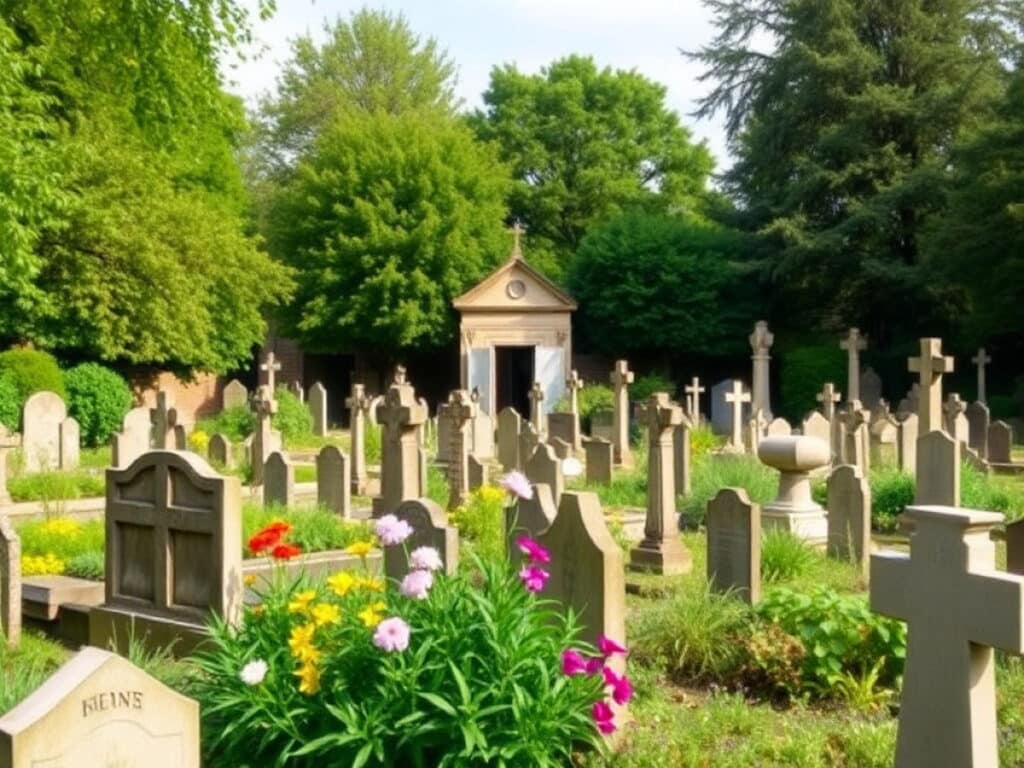
Constructed in the 19th century, a collection of London cemeteries known as the “Magnificent Seven” have transformed into scenic walking spots teeming with birds, rare insects, and hundreds of plant species. An enthusiast gave us a tour of Nunhead Cemetery.
London (United Kingdom), report
Why the 12-5-30 Incline Walking Method Is the Ultimate Fat-Burning Workout, According to Fitness Experts
The ultimate trick to banish mold from your bathroom grout in just 7 minutes—no vinegar or baking soda needed
In the early 19th century, as London expanded during the Industrial Revolution, the cemeteries surrounding its small Anglican churches reached capacity. From 1832 to 1841, seven private garden cemeteries were established in what were then rural areas on the outskirts of the city: the Magnificent Seven, carefully planted and landscaped according to Victorian era norms. These sites, now preserved as natural spaces, are today of great ecological value.
The 20th century brought challenges—rising maintenance costs, the popularity of cremation, and lack of profitability—leading to a period of decline and even neglect. In Nunhead, 6 km south of the Tower of London, the gates of one of the Magnificent Seven were locked in 1969 following the bankruptcy of the London Cemetery Company, and the staff departed.
“From that point, nature began to take over,” says Jeffrey Hart, secretary of the Friends of Nunhead Cemetery (FONC), which was founded in 1981 to maintain these 21 hectares of semi-wild mausoleums, trees, and tangled vegetation.
Their goal is to preserve the cemetery’s historical character through its original plants, while also supporting biodiversity. The burgundy-painted gates—a color of mourning at the time—lead to a grand lime tree avenue that heads towards the chapel, unchanged since its planting shortly after the site’s consecration in 1840. Only two trees are missing, one lost to a storm, the other to disease.
A few dozen meters away, hidden in the underbrush, a tall ginkgo tree stands guard over a catacomb. “In the past, it would have been visible from the path and a sign would have explained its origins. These spaces were intended as gardens, both to mourn the dead and to educate the living,” Hart explains as he navigates through the area. The bushes and plants that cover the tombstones are all symbolic: holly represents Christ’s crown of thorns, yew signifies mourning, hawthorn rebirth, the white berries of snowberries purity, and ivy immortality…
Hart stops in front of a bush with dark leaves. “Elsewhere, ivy is seen as invasive. Here, it has ecological value: it’s one of the few plants that produces berries in winter, which is crucial for birds that also use it as habitat.” He uses an app on his phone to record the bird songs overhead.
“We hear… a blackbird, a blue tit, a chiffchaff, a blackcap, and a jackdaw. These are the most common, but at least sixty species have been documented here.” Crows and ring-necked parakeets vie for the best spots.
Between the cemetery’s closure and its acquisition by the municipality for one pound sterling in 1975, a secondary forest of ash and sycamore trees spontaneously formed. “Seeds arrived, carried by the wind or bird droppings. They need little to germinate, and these trees grow quickly to expand the canopy.” This isn’t without damage: by absorbing soil moisture, they harm some monuments, while their proximity promotes disease transmission.
However, there’s no plan to cut them down. “Sometimes, we might fell a tree to preserve an important monument; other times, it’s the monument that will suffer because the tree needs to be preserved.” The remaining stumps provide shelter for stag beetle larvae, Europe’s largest beetle.
In the darker undergrowth, hardy species thrive: nettles, brambles that attract bumblebees and produce berries “loved by humans as much as by foxes,” and dense bushes of buddleia, the butterfly bush. “The soil is a real seed bank. Just prune back and watch what grows in each sunlit patch.” Along a cleared path, there’s a carpet of wild garlic, daisies, clover, and primroses, home to colonies of butterflies, hoverflies, dragonflies, and various moths.
“We try to diversify plant species to provide a variety of habitats for different species. The goal is to find a balance between heritage and ecology,” explains Hart. The association has thus planted a dozen disease-resistant elms and its very first magnolia. “This approach also continues what the Victorians did: collecting and showcasing interesting specimens.”
This diversity makes it a playground for experts, who come to study bats, rare lichens nestled in engravings, and spiders fond of dark crypts.
At Nunhead, entomologist Richard Jones has observed several species of very small beetles: synchita undata, synchita separanda, enicmus brevicornis, and diplocoelus fagi. “This is the first site where all four have been observed simultaneously in 1991, which has helped us better understand their natural history,” he explains via email. “Previously, they were all considered very rare species typical of ancient forests.”
Since its foundation in 1981, the FONC has grown to 850 members. Thematic guided tours are organized every weekend. “We learn by doing,” Hart shares. “Each of the Magnificent Seven has its own management and does things in its own way.”
Kensal Green, the largest, covers nearly 30 hectares. Tower Hamlets, where dogs are not allowed, hosts over 1,110 different species and is designated a “Metropolitan Site of Importance for Nature Conservation.” Highgate charges an entry fee but also attracts more tourists, who visit Karl Marx’s grave, among others. The West Norwood crematorium is still operational, and Abney Park, designed as an arboretum, has its own team of ecologists.
In 2003, Nunhead Cemetery became a “local nature reserve” as well. A section remains open for burials since 1975, and projects to support biodiversity continue: the creation of a pond, the delineation of meadow areas to allow wildflowers to grow, and the planting of hedges…
However, balancing the different uses of the space is necessary. “We have people who come to find family members or to research the Victorian era. Others study the wildlife. Others come to breathe and escape the city, have picnics… During Covid, it was incredibly busy!” Joggers weave between the monuments.
“We estimate that in the Magnificent Seven, only 9% of visitors are visiting a loved one,” says Zosia Ladds, a sustainability project manager at King’s College. “So it’s essential to find the right mix between having visible, clear paths and leaving space for wildlife.” According to her, the public’s attitude is key: “The fact that these sites are cemeteries generates a certain respect, which is as beneficial to biodiversity as effective management.”
Locking the gates at night also plays a role. Each evening, the main gate is closed, with its overturned metal torches announcing entry into the realm of the dead and its ouroboros snakes biting their tails to symbolize the cycle of creation and destruction. Despite these grim symbols, at dusk, it is indeed life that overflows.
Similar Posts
- Plants, Not Graves: How Natural Cemeteries Are Safeguarding Biodiversity
- Discover Nature’s Symphony: A Unique Birdwatching Experience for the Visually Impaired
- Mimosa Invasion: Beloved Garden Plant Threatens Local Ecosystems
- Create Bird Sanctuaries Everywhere: Help Our Feathered Friends Thrive!
- Thousands of Succulents Uprooted from Desert: The Dark Side of Home Decor

Hi, I’m Ashley from the Decatur Metro team. I share essential information for a sustainable and responsible lifestyle.