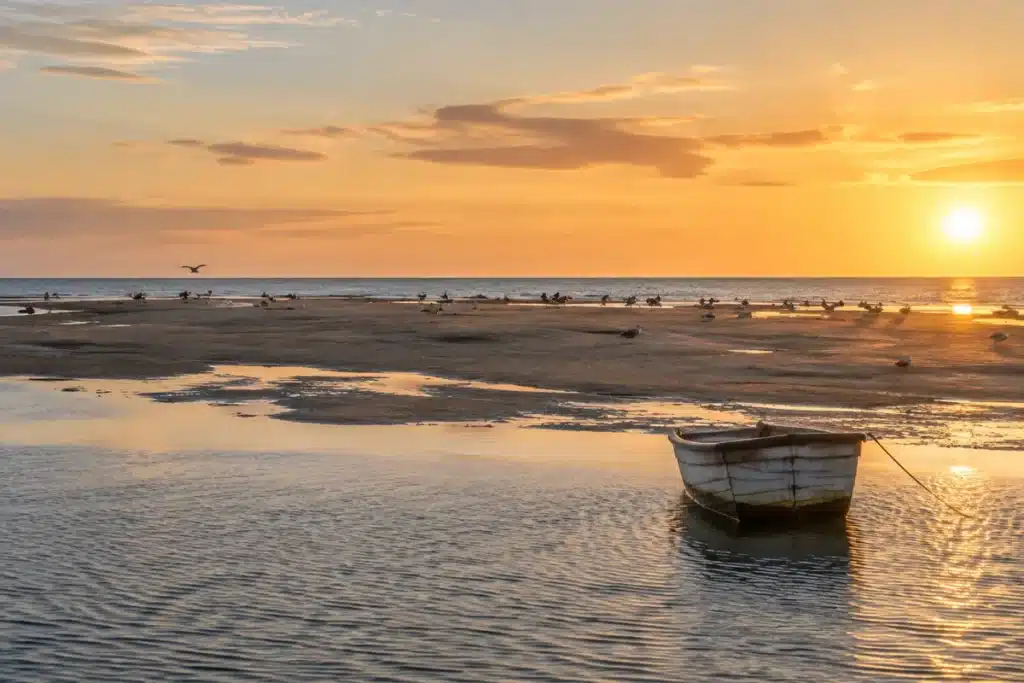
Banc d’Arguin (Gironde), report
Holding a spotting scope in one hand and a handheld tally counter in the other, Paul Capbern scans a cluster of young gulls resting on the sand. “I’ve counted 89,” he says, the ornithologist and reserve warden noting the figure with a click. That number is roughly one-sixth of what was recorded at the same time last year. In April, surveyors logged about 800 nests, but most of them have since been wiped out. Capbern explains that storms and unusually high tides have buried eggs and chicks; many young gulls have died after being overwhelmed by flooding.
A narrow ribbon of fine sand at the mouth of the Arcachon basin and reachable only by boat, the Banc d’Arguin is famed for its wildlife. Every year thousands of seabirds use the shoal to nest directly on the sand or to rest during migration. Benoît Dumeau, the reserve’s curator, emphasizes why the site is so attractive: there are essentially no terrestrial predators—no foxes, no dogs, no wild boar, and very limited human presence—so it is an ideal refuge.
Why a Simple Mistake in Your Online Pension Application Could Cost You Your Retirement Benefits
The ultimate trick to banish mold from your bathroom grout in just 7 minutes—no vinegar or baking soda needed
The reserve team visits the bank every month to tally seabird numbers, and during each outing they watch the sandbank shrink. Subject to storms and tides, the islet is steadily eroding: five years ago its length reached some 7 km; today it measures only about 2.5 km. This natural dynamic has been intensified by stronger winter storms and sea-level rise, placing nesting species such as gulls, the Kentish plover, and the Eurasian oystercatcher in increasing jeopardy.
These shore-dependent species return each year, often returning to the same places and nesting as close to the water as they can. Dumeau worries that there are no higher, safer spots left: with every spring tide of large amplitude, waves simply wash nests away. “I’m not certain there will even be a Banc d’Arguin next year,” he admits.
In the 1960s the bank’s combination of ideal sandy habitat and absence of predators drew the first breeding colony of sandwich terns. Back then the bank was open to anyone, and that freedom invited abuse: visitors and boaters were sometimes seen throwing eggs or removing live chicks. The public’s mistreatment prompted conservationists to act, and the natural reserve was created in 1972.
Fifty years on, sandwich terns have moved on, but other species have taken their place and public access has been substantially reduced. As Dumeau points out, the reserve today protects not merely single species but an entire ecosystem.
The threats are different now but remain numerous. Erosion is shrinking the bank relentlessly; while it is a natural process, climate change has amplified it, with more frequent and intense storms and a rising sea level. The reserve team cannot halt the larger geophysical forces, but they are working to protect what remains. “We try to shield these species because it is almost impossible to find comparable conditions elsewhere—areas free of people and land predators,” Dumeau says.
This summer brought another difficulty: a heatwave. Marion Celik, one of the wardens who leads educational activities, recounts seeing a gull chick sheltering behind a post to escape the sun. High temperatures are also hard for these birds to withstand.
From the reserve boat the technicians count freshly hatched gulls and a few oystercatchers born in recent weeks, along with whimbrels that stop on the bank during migration. The monthly censuses provide data on population trends; when figures look worrying for a particular species, managers can implement protection measures. Celik points to the Kentish plover as an example: this small shorebird, which nests directly on ocean beaches, numbers only about 1,200 breeding pairs across the country.
Laying eggs on open sand makes the plover extremely vulnerable—to human disturbance, to coastal erosion, and to natural predators. “Last year we recorded seven nests and observed some juveniles fledging,” Celik remembers. “This year there are none. It’s a species that could disappear here soon.”
To maintain protection in the face of the eroding bank, the Marine Natural Park has for the first time designated new protected breeding areas along the shoreline. There has been some displacement: this year a few oystercatchers nested at the base of the Pilat dune, on the mainland across the channel that separates the shoal from land. But whether all the birds would move permanently to the coast if the Banc d’Arguin vanishes remains uncertain.
One threat can still be reduced by human intervention: people themselves. “When the bank is gone, nesting is affected and there’s nothing we can do about that,” says reserve warden-technician François Dindinaud. “Our job is to protect what remains from human disturbance.” Since 2017 the state-mandated manager, Sepanso Aquitaine, has each year set out “zones of full protection” where public access is forbidden to ensure the birds can breed in peace.
Summer is both nesting season and peak tourist time. By midmorning dozens of boats already cluster in the shallow, clear water surrounding the shoal at low tide. As soon as Celik steps onto the sand she huffs in exasperation: a scattering of beer bottles and chip packets litters the shore. “That happens all the time,” she says.
That contradiction is at the heart of Arguin: part of the bank remains open for visitors to swim or share an evening aperitif, while other sections are strictly off-limits, with mooring banned in those fully protected areas. To enforce these rules, Sepanso staff have police powers under the environmental code. Dindinaud, wearing a shirt labeled “police,” explains that the most harmful infringements are unleashed dogs and drone flights, which the birds interpret as predators and may cause them to flee nests.
A family with a beached motorboat drives off birds as it revs the engine near the rope marking a protected sector. Dindinaud approaches with a whistle and reminds them of the law. “Do you know you’re in a nature reserve? It’s prohibited to anchor here,” he tells them. The vacationing family is let off without a fine; they claim they weren’t aware the area was protected, despite signage on the sand.
According to the wardens, their enforcement tasks have become more complex since 2020. “A few years ago it was manageable; we might have had forty boats. But over the last five or six years the population around the basin has exploded. Last year we had 1,200 boats anchored at the same time,” Dindinaud recalls.
New patterns of use have worsened the situation: the growth of Click&Boat, a peer-to-peer boat rental platform modeled on Airbnb, lets people go to sea without receiving any briefing about protected zones. “People don’t book through an agency anymore, they don’t get a briefing, and they don’t check the rules,” Dindinaud complains.
Most of the time a reminder of the rules suffices, but teams have sometimes been pushed aside or even threatened. “People have difficulty understanding why they can’t do what they want on the bank—they treat it like their own place,” Celik observes.
Over the past five years Sepanso Aquitaine has shifted toward prevention rather than heavy-handed fines: they invite school groups, boating clubs, and fishermen’s associations to explain the reserve’s high level of protection and the real reasons for the restrictions. Last year the team recorded 1,500 offenses but issued fines in only about 2% of cases. This season, Dindinaud says, there are signs that their outreach is having an effect: now that much of the bank has nearly disappeared, both locals and visitors are beginning to support efforts to protect the last birds that can still nest there. “Better late than never,” he says with a small smile.
Similar Posts
- Barn Owls in Crisis: Old Attics Needed for Nesting Havens
- Eagle Killed by Wind Turbines: New Law Clears Company of Blame
- Endangered Bird Faces Extinction: High-Voltage Power Line Threatens Rare Ganga Cata
- Europe’s Largest Raptor at Risk: The Critical Hunt for Bearded Vulture Nests
- Eagle and Falcons Killed by Wind Turbines: EDF and Valeco Found Guilty

Hi, I’m Ashley from the Decatur Metro team. I share essential information for a sustainable and responsible lifestyle.