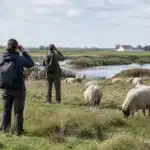
The wolf’s return to the high pastures has transformed the work of breeders and shepherds. Despite the stress and the adjustments it forces on their routines, some say coexistence with the predator is possible.
Alpes-de-Haute-Provence, Hautes-Alpes and Drôme, reporting
“The wolf is a taboo subject, that’s for sure.” Back from his summer season in the high pastures, Jojo agreed to meet in a café in Gap (Hautes‑Alpes) at the end of October to talk about wolves — on one condition: like the other shepherds and breeders who spoke with Decatur Metro, he insisted on remaining anonymous. Within livestock circles the topic is deeply divisive.
Why a Simple Mistake in Your Online Pension Application Could Cost You Your Retirement Benefits
The ultimate trick to banish mold from your bathroom grout in just 7 minutes—no vinegar or baking soda needed
“When the topic comes up at the table, for example during a meal with other breeders, I try to stay fairly discreet,” says Louise, who has worked as a shepherd in the Southern Alps for about fifteen years. She describes her stance as “rather nuanced,” and worries it could be poorly received by some of the farmers she works for, who are more hostile to the wolf’s comeback. “I’m not anti-wolf, and I’m not pro-wolf either,” she says. “I simply think the wolf is part of an ecosystem we’re trying to fit into. Personally, I respect its presence.”
Respecting the wolf’s presence in the mountains despite the undeniable constraints it brings — that is the position defended by Louise, Jojo, Éliott and Max, all breeders or shepherds working in the Alps. Although a minority in agricultural circles, this outlook is reportedly shared by about one third of breeders in the French Alps, according to a 2023 survey carried out within the EU Life Wolfs programme. Yet this perspective remains largely absent from mainstream coverage, which often frames the issue as urban environmentalists in favor of wolves versus a countryside uniformly hostile to them.
Julien observed this range of opinions during the years he spent in the “wolf unit.” This special team of the French Office for Biodiversity (OFB) assists livestock owners in setting up protection measures: night enclosures, guardianship, and so on. When those measures fail, the unit is also authorized to shoot wolves. “I’ve seen everything: people extremely opposed to the wolf and people extremely in favor of its return,” says this former OFB agent, who has since left the role.
Even though they all face predation, shepherds and the farmers who employ them do not necessarily feel the same about wolf damage. “We have a different relationship to the flock than a breeder who sees his ewe born and sometimes raises it on a bottle,” explains Jojo, who has been a shepherd for five years.
Owners of the flocks — the breeders — are directly hit financially by attacks. They also bear losses that aren’t factored into compensation calculations: miscarriages, reduced milk yields and complications at lambing triggered by the stress of predation.
By contrast, shepherds can be seen as indirectly “benefiting” from the wolf’s return, since breeders are now obliged to provide more active supervision of flocks — where in the past animals might have ranged more freely on the summer pastures. “The wolf, by force of circumstances, has also revitalized the shepherding profession,” Julien notes.
In fact, shepherds’ wages are largely subsidized under the State’s Wolf plan: the government covers about 80% of those salaries. According to the association Ferus, the bulk of funds allocated to the wolf are used to create or preserve roughly 2,000 pastoral jobs. “If the wolf hadn’t come back, we certainly wouldn’t have this work. And in some ways, it gives meaning to what we do,” Jojo says.
Reducing the situation to a simple split between shepherds and breeders would be misleading. The boundary between these groups is porous: many breeders were shepherds themselves or still take flocks up to the high pastures in summer. Max, for example, is a migratory breeder with around 200 ewes who also watches over other people’s flocks on the alpage. With some twenty years’ experience, he has noticed attitudes toward the wolf shifting. “Year after year, it’s opening up a bit: people are starting to say that yes, we can live with it,” he says.
His colleague Éliott, also a breeder, shares his farm with a wolf pack that settled nearby. Camera traps let him follow the pack’s daily life; at times it has numbered up to eleven individuals, including pups. “I’m lucky to live in a territory where the pack is very diplomatic,” Éliott says, admitting he was “surprised” to have suffered so few attacks.
He credits that to the abundance of wild boar around his farm and to the protection strategies he has adopted — and also to a bit of luck and the pack’s hunting habits, which do not seem to target flocks.
People’s positions also vary according to their personal experiences and the kind of attacks they’ve endured. “I’ve never had a big attack,” Jojo acknowledges. “The wolf has always come for sick animals, ones that were already fading… This summer, for example, we had many more losses caused by health problems than by attacks.”
Max did not have that luck. A few years ago he lost “about sixty” ewes in a single summer — roughly a quarter of his flock. “At the time, it certainly provoked anger against the wolf,” he admits. “But it’s part of the game, part of life.”
Éliott shares this philosophy and judges the attacks “largely bearable” thanks to State financial support. “I receive around €10,000 a year in wolf-related aid, of which €4,000 goes on kibble and veterinary care for the dogs and about €6,000 on shepherd wages. In my view, we’re extremely well supported.”
His willingness to accept the wolf’s presence has even led him twice to oppose proposed shootings that others wanted to carry out as part of their work. When neighboring flocks had been attacked, local breeders requested the intervention of authorized shooters. Judging such shots “unjustified” given the small number of attacks he endured, Éliott refused to let those shooters set up near his hut while they waited for the predator.
Yet, like every shepherd and breeder interviewed for this report, he does not reject shooting wolves in principle: “I’m not beyond having to kill a wolf myself if I find myself in an unmanageable situation with my pack,” he says.
One thing is clear: Max, Éliott, Jojo and Louise do not question the wolf’s right to be in the high pastures. “Being for or against the wolf doesn’t make sense. It’s like being for or against lightning,” Éliott says. None of them has known these mountains without wolves, and all express a sensitivity to wild species — Jojo, for instance, who “came to the job out of a love for the mountains.”
“I start from the premise that we’re the ones who are going into its home, not the other way around,” Max adds. Their efforts now go toward a common goal: finding their place inside a natural ecosystem that humans once ruled unchallenged and which they are now learning to share again.
QUOTAS FOR KILLING
Each year the State sets a “destruction ceiling,” the number of wolves that may be culled. Until 2025 this ceiling could not exceed 19% of the wolf population estimated that year by the OFB (which equated to 190 wolves allowed to be taken). In 2026 the rate was raised to 21% of the population, and it may go up to 23% if the quotas are reached too early in the year. Naturalist associations consider these quotas too high, while the agricultural union FDSEA finds them too low and campaigns to have the wolf removed from the list of protected species. In practice the quotas are frequently exceeded, because some wolves are illegally poached outside the legal framework.
Similar Posts
- Mexican Ranchers Embrace Wolves Instead of Hunting Them: A Tale of Peaceful Coexistence
- Wolf near Col Agnel in France does not attack livestock and shows little fear of people
- Zachary Quinto’s Eye-Opening Insight: Can Oliver Mend His Broken Bonds with Josh?
- Law & Order Toronto: Criminal Intent Debuts This Fall on The CW!
- Dick Wolf’s “On Call” Axed After Just One Season: Will Another Streamer Revive It?

Hi, I’m Ashley from the Decatur Metro team. I share essential information for a sustainable and responsible lifestyle.