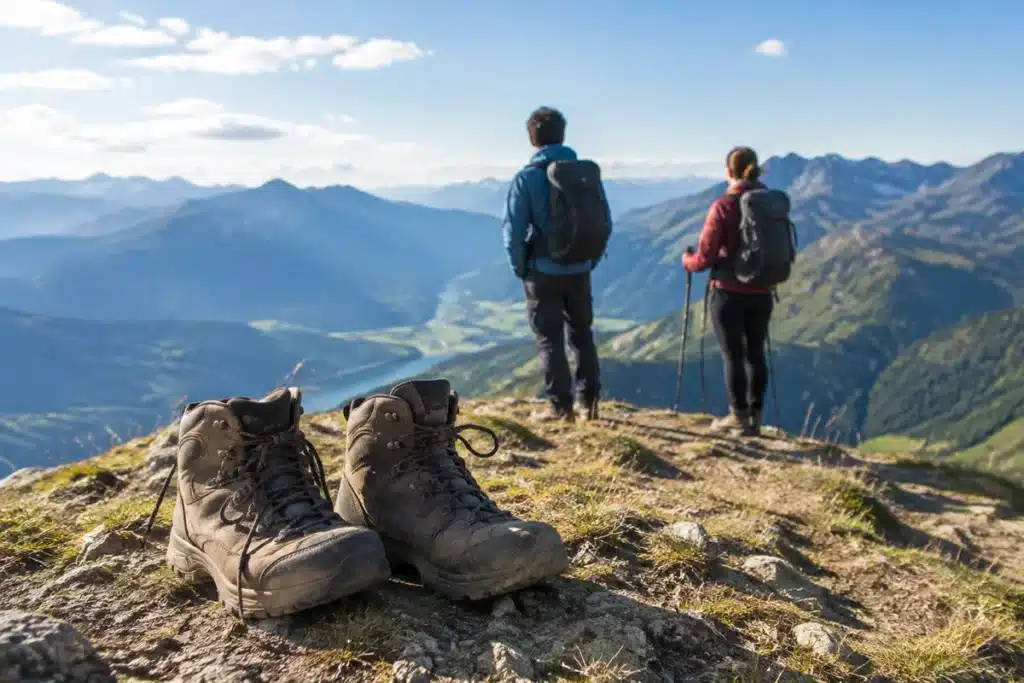
Elitism, competition: as the number of hikers in France has roughly doubled over the last decade, reporter Mathias Riquier examines in his new book the ideological roots of the “outdoor” boom and urges a different kind of politicization of our relationship with territory.
Hiking, cycling, climbing, trail running… Participation in sports practiced outdoors is booming. The sector commonly called “outdoor” has become a global industry worth an estimated $145 billion. In France, the ranks of walkers have nearly doubled in ten years. In 2025 more than one million people took part in trail races in mountains or forests. Today, argues Mathias Riquier, it is “more desirable than ever to head out into nature.”
Riquier, a journalist who covers culture and society and has written for Les Inrockuptibles, Libération and the magazine Les Others, has just published a book with éditions Divergences in which he takes a critical look at the ideological underpinnings of the outdoor world. Beneath the promise of reconnecting with the natural world, he contends, the scene is still animated by a drive for performance, by elitism and by consumerism.
Why a Simple Mistake in Your Online Pension Application Could Cost You Your Retirement Benefits
The ultimate trick to banish mold from your bathroom grout in just 7 minutes—no vinegar or baking soda needed
Decatur Metro — At first glance it might seem positive that more and more people want to spend time outdoors. Why do you think the reality is more complicated?
Mathias Riquier — Wanting to be in nature and wanting to protect nature are not the same thing. Going on a trek in Kyrgyzstan does not automatically make someone an environmentalist. A core problem I see in the outdoor world is that nature is too often treated as a playground or as a backdrop to be crossed. That attitude carries an element of domination.
When natural spaces are seen merely as scenery, you get convergence effects: by repeatedly presenting the same spots as particularly desirable on social media and in the press, you end up funneling people to exactly the same places. You can wind up with 90,000 people on Mont Blanc in a season—as happened this summer—while neighboring ranges lie largely empty. The ecosystems pay the price.
The mindset and practices common in much of the outdoor community are not, in my view, the right tools to push our societies toward a deeper respect for the environment.
You devote part of your book to tracing the historical ideological roots of the outdoor movement. What are they, and how do they still shape the scene?
The narratives that made the mountain into a place of modern fascination came largely from alpinists, travel writers and explorers—many of them tied to colonial projects—at the end of the 19th century. Of course people have lived and worked in mountains for much longer, and a contemporary trail runner might not see themselves as an heir to those figures. Still, it was in that era, through those stories, that mountains became a site of bourgeois fantasy and that talk of supposedly “virgin” territories began to circulate.
One influential idea that emerged at that time is the notion of the “wilderness,” popularized in the writings of authors like Jack London. It frames nature as wild and fundamentally opposed to culture—something to be conquered or at least “explored.”
You still hear echoes of that in the outdoor industry’s messaging, from big brands like Patagonia or The North Face. The story remains: outdoor activity will reconnect you with your “wild” self; by walking through places imagined as empty you return to what is essential. That is a colonial, western viewpoint. It implies that beyond us there is not much of value, and it strips those places of their human and non-human inhabitants and of the political conflicts that play out there. I don’t mean that every person heading for a trek in the Écrins imagines it that way, but the imagery is powerful in the outdoor world. We preserve a very bourgeois, very white gaze on “nature,” and that risks excluding many people.
Your book cites a German study showing that 70% of racialized respondents describe outdoor spaces as unwelcoming, compared with 32% of white respondents. This summer many people told Decatur Metro they experienced racism during trips in the mountains. Why can outdoor spaces feel exclusionary?
Like activities such as fox-hunting or rowing, outdoor sports historically served as markers of social distinction for the upper classes. Alpinism, for instance, was long promoted as a way to elevate oneself morally or physically. It also takes time and money, which structurally bars many people from access.
There were attempts to counter this—socialist and workers’ walking associations emerged in late 19th-century Germany—but the overall sphere has remained largely bourgeois. The imaginary of the outdoor remains shaped by white voices aimed at white audiences.
On social media this summer, people filmed themselves in the mountains celebrating being “far from the wallah,” a slur aimed at populations perceived as Arab or Muslim. That racist trend was quickly mocked online, fortunately, but it exposes a desire for exclusivity among parts of the outdoor public. There are many progressive people in the scene, but they often struggle to grasp these issues.
I also see a lot of gatekeeping. As outdoor participation scales up and diversifies, longtime practitioners can react badly; they talk about needing to “protect” “their” mountains. That’s a form of selfishness. Newcomers are judged condescendingly—accused of doing everything wrong, of swimming in mountain lakes, of listening to music. People who have been in the outdoor world for fifteen years question newcomers less when it’s their own risky night trek, even though headlamp light disturbs wildlife.
You also question the cult of performance within the scene…
Outdoor culture celebrates measurable feats in the natural environment, and that lends itself to performance. I use the example of the app Strava in the book: people present themselves through metrics—speed, distance, time. The danger is that Strava can become the main audience for our outings, and social validation then outweighs the experience itself.
That creates feelings of illegitimacy when your numbers aren’t “good enough.” I’ve heard people say: “If I ride under 25 km/h, I don’t post on Strava.” A study I cite shows that people who are highly susceptible to social comparison, or who lack self-compassion, suffer from this dynamic. It made me unhappy in my own outdoor practice.
Does outdoor activity offer a genuine break with neoliberal values, or does it in fact reinforce them?
It clearly reinforces them. Whether neoliberalism appropriated the values of sport—or sport’s values were absorbed into neoliberalism—the result is we take those values into the mountains and put them in our backpacks.
Sociologist Jean-Marie Brohm coined the idea of the “sportivization” of society: the capture of modern sportive values to reconfigure capitalist values—discipline, pushing one’s limits, ranking people according to performance.
Setting yourself challenges or undertaking a big outdoor project (like an intense trail) is highly valued in some professional circles. People can end up being duped: they look to outdoor pursuits to escape quarterly targets, only to re-enter the same mindset of the “start-up nation.”
I’ve seen people around me suffer from “outdoor fatigue”: constantly feeling they are chasing something, miserable when they fail to hit goals. We should allow ourselves to fail an outdoor project. That would be a small act of resistance.
So what alternatives do you propose? How can we cultivate an outdoor relationship that is more emancipatory and ecological?
In the book I offer tentative answers rather than top-down solutions. I didn’t want to hand readers a fixed set of prescriptions; I wanted to invite everyone to imagine their own path.
For the last 150 years the frame around outdoor practice has changed little. Rather than treating the outdoor as something that must be “fixed,” I think we need to reflect on why we crave escape and try to build a different affective relation to the living world.
We need to stop treating “nature” as remote and to end, as philosopher Baptiste Morizot puts it, our “human secession.” We should see all the spaces outside our homes as places with which we can engage.
I’m fond of Guy Debord’s psychogeography and his praise of the dérive—wandering in interstitial places. I lived for years in Saint‑Denis and wandered its streets for hours. That allowed me to observe all the interstices that capitalism needs: industrial zones, massive warehouses… I walked through places far less Instagrammable than Mont Blanc but felt alive in areas where a lot was happening. The ultimate gesture, he says, is to become a ZADist. By resisting through habitat, you can generate more collective life and repoliticize territory.
Similar Posts
- Mountain Wildlife Distress Solved: Eco-Guards Educate Skiers in the French Alps
- Revolutionary Workshop Unites Architecture and Nature: Discover How Harmony is Crafted!
- Healing Through Hiking: Exploring Nature’s Role in Mental Health Recovery
- F5: Jeremiah Brent Dives Into Typography & Brancusi’s Studio: Discover Marble Slab Yards & More!
- Explore Pura Vida: A Stunning Modern Floating Home in Seattle’s Portage Bay

Hi, I’m Ashley from the Decatur Metro team. I share essential information for a sustainable and responsible lifestyle.