Every now and then, a game comes along that quietly changes everything. You boot it up expecting the usual thrills, and before you know it, you’re slack-jawed at your screen, wondering how on earth they pulled it off. That’s exactly what happened with Alan Wake 2—an unexpected masterclass in atmosphere, tech, and storytelling that has left gamers and critics equally gobsmacked.
A visual knockout no one predicted
Let’s not sugarcoat it—Alan Wake 2 looks breathtaking. From its first scene to its final twist, the game offers a visual feast that feels less like a sequel and more like a new benchmark. The facial animations alone deserve their own standing ovation. Whether it’s a nervous twitch or a subtle brow raise, characters come alive in a way that’s almost unsettling.
Take the local diner scene with Saga, one of the game’s dual protagonists. It’s a simple interaction—some polite questions, a couple of half-truths—but the level of detail in the characters’ expressions makes it feel more like a scene from a prestige drama than a video game. You don’t just play through it—you’re drawn in, unsettled, and oddly mesmerized.
Why the 12-5-30 Incline Walking Method Is the Ultimate Fat-Burning Workout, According to Fitness Experts
The ultimate trick to banish mold from your bathroom grout in just 7 minutes—no vinegar or baking soda needed
The game’s director, Sam Lake, promised it would be Remedy’s most beautiful game to date. That wasn’t hype. That was a prophecy.
Built on custom tech with serious power
The game’s astonishing realism owes a huge debt to Northlight, Remedy’s in-house engine. If you played Control or Quantum Break, you’ve already had a taste of its capabilities—but what we see in Alan Wake 2 is something else entirely.
One key upgrade? A shift to an ECS-based architecture (Entity Component System), which allows for larger, more dynamic worlds while keeping performance tight. It’s the reason why the game’s environments—from haunted forests to flickering motel rooms—feel so dense, alive, and reactive.
Northlight’s improvements also shine through in gameplay systems like the Case Board, a visual tool that lets players organize clues. It’s more than just stylish—it’s smart. Developers credit ECS for letting them build and tweak features quickly without sacrificing performance.
A world so immersive, you’ll want to frame every scene
It’s not just characters and dialogue that make Alan Wake 2 a stunner—it’s the world itself. Remedy’s new GPU-driven rendering pipeline allows for a staggering level of environmental complexity. We’re talking forests thick with detail, weather effects that tug at every leaf, and lighting that dances across rain-soaked roads with unsettling realism.
Characters now navigate spaces more naturally thanks to voxel-based control updates, which means no more awkward stuttering in tight corners. Even NPC movement has seen a revamp, thanks to a smart distance-based matching system that helps keep animations smooth and believable.


Weather, light and fog like you’ve never seen before
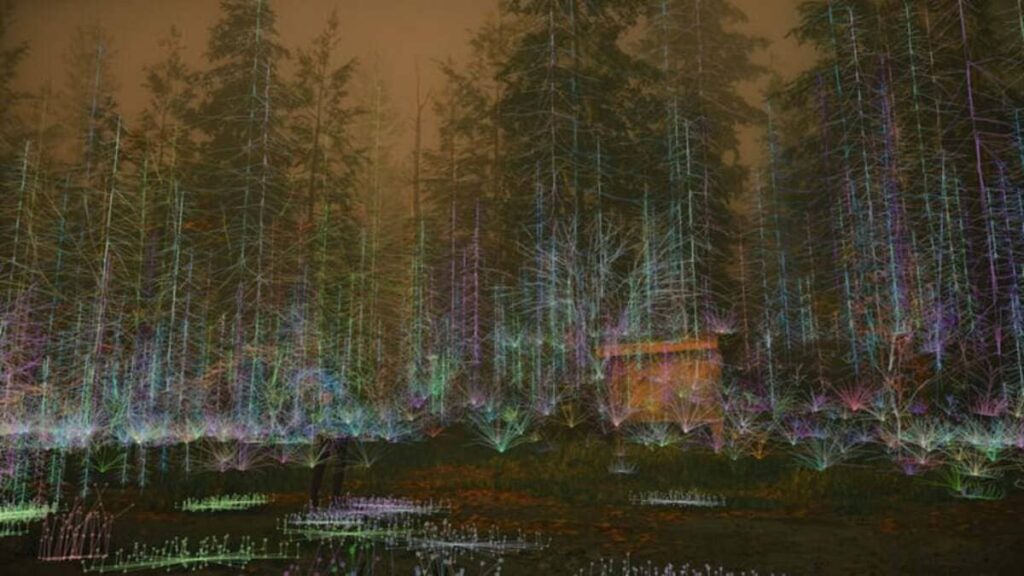
Here’s where Remedy really flexes: the weather system. It’s not just cosmetic—wind now has physical consequences. It rustles trees, bends cables, and adds real heft to the atmosphere. There’s even a tool to generate sprawling vegetation zones, each plant animated with its own shader-driven “bones” for stunning realism.
Then there’s the fog. Yes, the fog. Powered by a techy-sounding system called MBOIT (Moment-Based Order-Independent Transparency), it creates the kind of moody haze you’d expect in a cinematic thriller—not a video game. The system blends fog, transparent geometry and visual effects so seamlessly you might forget it’s all virtual.
Finally, there’s the ray tracing. If you thought it looked good in Control, Alan Wake 2 takes it to the next level. Shadows feel heavier, light behaves more naturally, and even animated foliage benefits from new skinning techniques that make every tree branch feel alive.

Next-gen finally means something
While plenty of games have claimed to usher in the next generation, Alan Wake 2 actually delivers. It’s not just a looker—it’s an experience. One where every element, from the gameplay to the graphics, works in perfect, eerie harmony.
This wasn’t just a sequel. It was a reminder that, sometimes, the most powerful punches are the ones you never see coming.
Similar Posts
- NBC’s “The Traitors” Goes Civilian: Apply Now for the All-New Season!
- Andor Season 2 Death Predictions: Who Will Die and Who Survives from Rogue One? Vote Now!
- After winning the lottery 7 times and €1 million, he finally shares his secret technique
- The secrets behind the “invisible car” tricks: why more drivers are outsmarting speed cameras
- Don’t Fret: ABC’s Match Game Revival Is Still Super Groovy – See Photos!

Hi, I’m Brandon from the Decatur Metro team. I guide you through the trends and events reshaping our region.