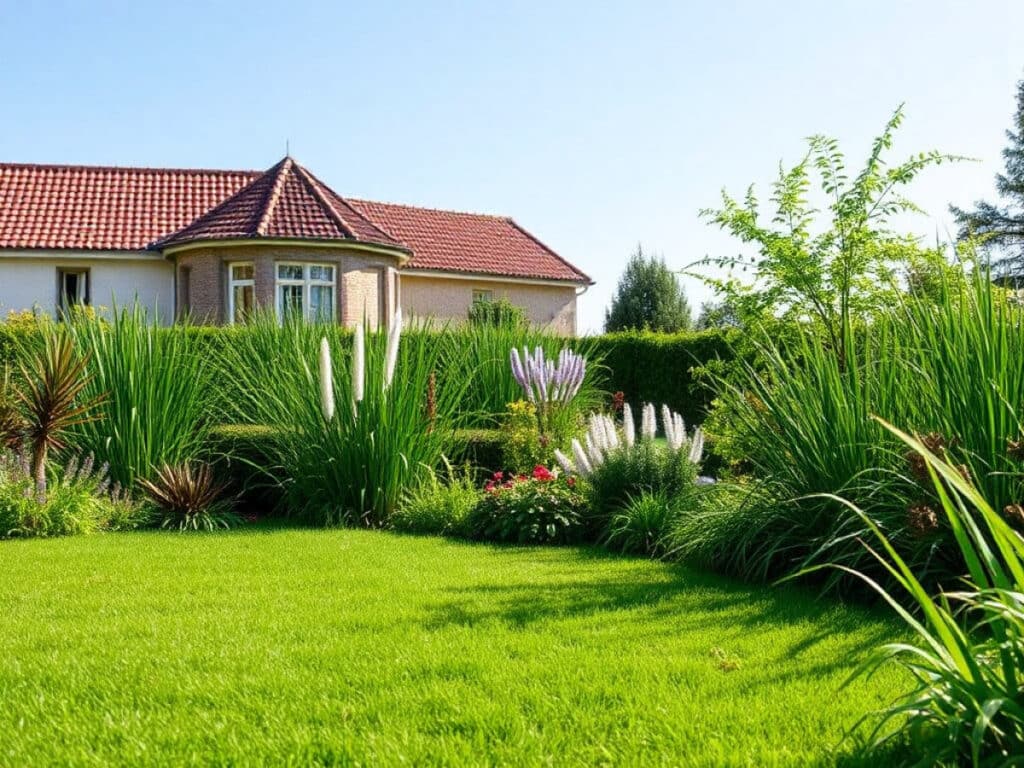
A sterile square of greenery that requires constant watering and fertilization, closely mown grass is an ecological absurdity. Some landscape gardeners are pushing back against the dominance of the lawn by promoting plant diversity.
Mèze, Hérault, reportage
Why the 12-5-30 Incline Walking Method Is the Ultimate Fat-Burning Workout, According to Fitness Experts
The ultimate trick to banish mold from your bathroom grout in just 7 minutes—no vinegar or baking soda needed
In the midst of blooming clusters of rockrose and sage, one feels transformed into a butterfly. Led by scents of honey, red fruits, and curry, we flit among the colorful bushes. By the Thau pond, the garden of Olivier and Clara Filippi seems like a paradise for the senses. Yet, across the 6,000 square meters of vegetation, not a single blade of grass. « Don’t even mention it to me! » the nursery owner quickly warns.
For him, as for many gardeners, a planted and closely cropped lawn is a folly. « An English-style lawn requires a lot of inputs; it needs constant watering, fertilizing, and mowing, explains Aymeric Lazarin, a landscape architect in the Alpes de Haute Provence. It’s akin to hyper-intensive farming. »
Even north of the Loire, the emerald turf is not universally admired: « It’s a disaster from an ecological viewpoint, he laments. The biodiversity is extremely limited, apart from blackbirds and a few rodents… » Despite its drawbacks, lawns continue to be popular: nearly 7 out of 10 French people have a garden with a lawn, according to the interprofessional organization of seeds and plants.
These grassy areas cover around 1.7 million hectares — including private gardens, sports fields, roadside verges, or public spaces — equivalent to three departments. And for the French Society of Lawns, these spaces « contribute to thermal regulation in urban environments, rainwater infiltration, and carbon storage in the soil ».
But what fuels this French passion for grassy ground cover? « It’s an atavism, a habit, we reproduce a collective pattern », asserts Éric Lenoir. « We have an instinctive and primitive need for greenery, but we have also learned to fear it, especially tall grasses, Aymeric Lazarin believes. The only nature we tolerate is the controlled, sanitized kind… thus, closely mown lawns. »
From his Mediterranean garden, Olivier Filippi also sees « a very gendered vision of the garden »: « Lawn maintenance is generally done by men, in an idea of mastering nature », he says. For him, we inherit an imagination forged over more than three centuries in Europe and North America.
The planted lawn originated in the 17th century in the gardens of Versailles under André Le Nôtre, « where it was maintained by dozens of workers with shears », Olivier Filippi narrates. A royal beginning, later adopted by British aristocrats in search of romantic landscapes.
However, it was in America that the lawn really took off, covering today more than 65 million hectares — more than any other crop, including wheat and corn. The lawn gradually became a symbol of social distinction and « a real moral imperative », according to historian François Jarrige.
« Far from being this peaceful little patch of natural greenery, the lawn is a symbol of the Promethean project of taming nature. Just like vacuuming or daily shaving, mowing the lawn becomes a civic duty and a sign of civilization. » Quite the agenda!
Then, how do we shake off this burdensome cultural ballast? At the French Society of Lawns, it is noted that « the entire sector is engaged in a dynamic of evolution and adaptation », mentioning in particular « the development of varieties more resistant to climatic stresses », the diversification of species used in mixes and « the optimization of maintenance equipment and practices ».
However, these alternatives still lock us in a deadlock, according to Olivier Filippi. « Instead, we should create gardens without lawns, with a much greater botanical diversity », he explains. Together with his partner, he has traveled around the Mediterranean basin to study these exceptionally biodiverse environments and collect seeds. Through experimentation, they have propagated thousands of drought-tolerant plants.
As a result, the Filippi garden hosts over 2,000 different species — including several hundred types of rockroses — much to the delight of insects and birds. « We aim to have a garden that is very productive in nectar and pollen throughout the seasons », he smiles.
Besides this fragrant mosaic, the two nursery owners have created pathways covered in gravel « to drain the heavy rains » and an « arid steppe » around the playground, made up of creeping thymes and other ground-cover plants.
And, in the shade of a tree, 15 square meters of zoysia — a ground-cover resembling grass, but much less water-demanding. « It’s a small area where we have our summer lounge, and we water it only with collected rainwater », the gardener specifies.
If all gardens were designed in terms of uses and differentiated spaces, we could limit grassy areas to a few well-defined zones: where we eat and entertain, where children play. « And even then, one might think that soccer games are more appropriate on the municipal field, with friends », suggests Éric Lenoir.
He also advocates for « reconsidering the amount of lawn we actually need »: « Generally, the area we mow is excessive, he points out. It’s about envisioning the garden differently. » A sentiment echoed by Aymeric Lazarin: « To start, you can diversify the lawn by introducing flowering plants, such as thymes, daisies, and creeping bellflowers… he lists. If we’re more daring, we can plant shrubs, trees, and leave a small corner of the garden completely wild. »
Varying the spaces and species, changing the layers… These are changes that require a shift in mindset. « Many people tell me it looks unkempt, the landscape architect notes. But consider all we gain by giving up the lawn: more biodiversity, less time and money on maintenance, and more summer comfort. »
In the shadow of a Cyprus strawberry tree with its flamboyant bark, Olivier Filippi listens to the song of a nightingale, watching a garden wasp pollinate a scabious flower: « See, there’s no lawn here, but one feels good in this garden, it’s a multisensory experience. »
Similar Posts
- Create Bird Sanctuaries Everywhere: Help Our Feathered Friends Thrive!
- “I’ve never seen my garden so beautiful”: The all-natural trick experts swear by to keep slugs away for good
- Stunning Modern Farmhouse Emerges: A Layered Architectural Marvel in North Vancouver
- Protect Local Wildlife Right Outside Your Door: How French Landowners Are Creating Biodiversity Sanctuaries
- “I’ve never seen my garden so healthy”: The underrated kitchen trick that keeps slugs away—science confirms it works

Hi, I’m Ashley from the Decatur Metro team. I share essential information for a sustainable and responsible lifestyle.