Following the fires that ravaged the Fontainebleau forest in early July, the National Forestry Office (ONF) and local associations are assessing the damage and considering the regeneration of the affected areas.
Fontainebleau (Seine-et-Marne), report
Why the 12-5-30 Incline Walking Method Is the Ultimate Fat-Burning Workout, According to Fitness Experts
The ultimate trick to banish mold from your bathroom grout in just 7 minutes—no vinegar or baking soda needed
«What brings you here?» We had just stopped at the edge of the Fontainebleau forest (Seine-et-Marne) to head to our meeting point when a motorcycle police patrol questioned our presence. Roads skirting the forest have all entry paths blocked by tape.
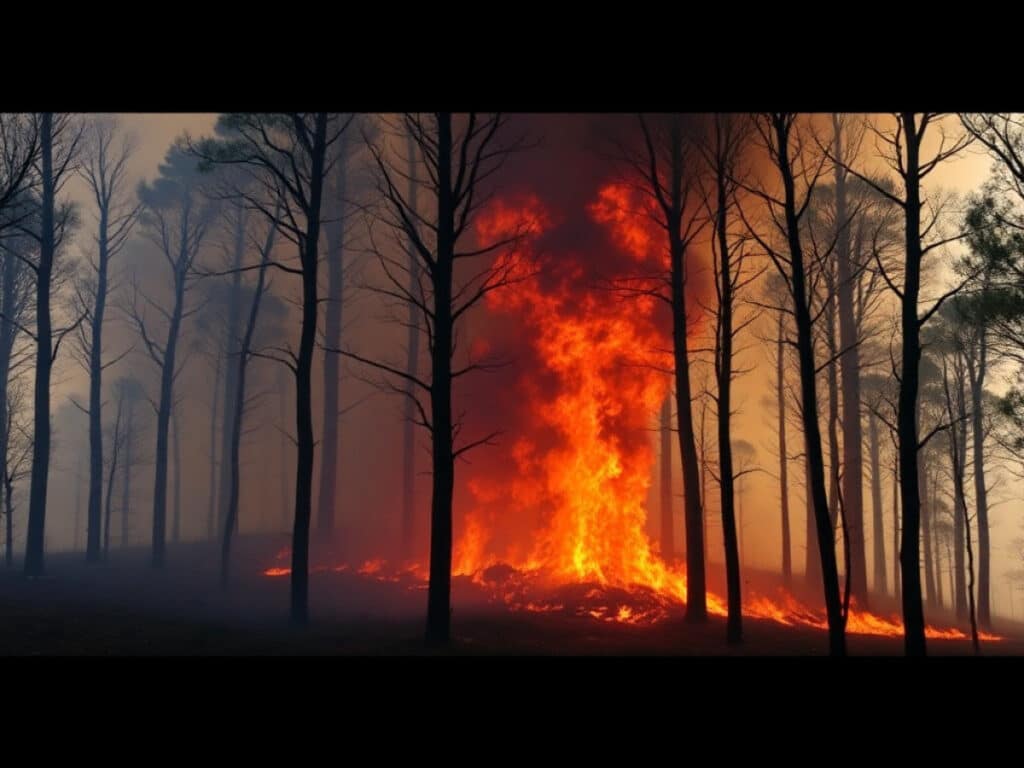
Since July 15, following a fire that consumed close to 2,200 hectares, the 22,000-hectare forest area, which usually welcomes up to 17 million visitors annually, has been completely closed to the public by a prefectural decree until further notice.
Daily, agents from the Forest Fire Defense System (DFCI) and the National Forestry Office (ONF)—who fought the flames alongside firefighters—monitor for any resurgence of fire and ensure that no one enters the forest. «We still saw a guy smoking a cigarette by the roadside this morning,» sighs Yann Guillemard, a DFCI agent. In his 17 years with the ONF, he had «never seen the forest in this condition, nor a fire of this magnitude.»
We venture deeper into the forest, heading towards the Haute-Borne sector in the southwest. The smell of burning is already overwhelming. The vegetation has turned yellow due to the drought. Along the way, Guillaume Larregle, responsible for biodiversity monitoring at the Loing Valley Naturalist Association (ANVL), insists on showing us what the unburned heath looks like.
«Stunned by the vegetation’s dry state,» the botanist shows us the heathers and heath, typical of the sandy and acidic soils that characterize the Fontainebleau heath. With repeated heatwaves, «heaths dry up standing with their leaves, and it can ignite like straw.»
«The soils here are already very draining and do not retain water, but there has been no real rain for two months and it is very hot,» observes Sophie David, head of environmental services and public reception at the ONF’s Île-de-France Est agency. A scenario that is «increasingly common» in summer at Fontainebleau according to the agent who has been with the ONF for fourteen years. For her, it would indeed take «just a small spark» for a fire to immediately restart.
When we reach the affected zone, just placing a hand on the ground reveals it’s still hot. «In some places, it’s still between 150 and 250°C in the soil,» explains Sophie David, confronted with a «lunar» landscape. Instead of a «field of purple and pink flowers,» typical of the season on the heath, the sandstone rocks are covered in ashes.
«On these sandstone slabs, the indentations hold rainwater and form temporary pools: large lenses of water where there were very rare plants,» sighs Guillaume Larregle of the ANVL. «It breaks my heart to see this,» he says, disheartened.
A whole mosaic of remarkable habitats have been affected. According to the ONF, 400 hectares of directed or integral biological reserves—allowing nature to express itself freely with little or no human intervention—have gone up in smoke, in addition to 125 hectares of heathland and 74 ponds crossed by the fire. These are «broken ecological continuities» and a set of ecosystems that have taken a major hit, summarizes Guillaume Larregle.
This forest that has been swept by flames is also «the work of several generations of foresters,» laments Sophie David of the ONF. Around us, the landscape is obscured by the trunks of charred pines. It’s the roots that Sophie David draws our attention to: «If some trees still have needles on their branches, their roots are burned or even dislocated in places, so they will die.»
The fauna has also suffered, but it is too early to take stock. Around a path bend, Guillaume Larregle is thrilled to hear the song of an Ephippiger, a rare and very localized grasshopper in the Fontainebleau forest. He immediately notes it down, contributing to the inventory that will need to be carried out post-fire. In total, 15,000 plant and animal species had been catalogued in the area before the fires, making it one of Europe’s richest biodiversity reserves.
«When we think of the animals that suffered from the fires, we most often mention large deer, like stags or does,» observes the naturalist. However, «they had a chance to escape,» while this is probably not the case for «small animals with limited mobility, such as reptiles or insects,» he points out. He is particularly concerned about species «that like old wood, like the great capricorn beetle,» or the woodlark, the Dartford warbler, and the European nightjar, birds «that nest on the ground in open habitats that burned.»
Contrary to appearances, «the fire is stationary, but it is not extinguished,» in areas that have been ravaged by flames. It «smolders in the soil» and specifically in peatlands. «Over the years, the organic material deposited on the surface mixes with sand, and it does not degrade because the soil is acidic, so it becomes fuel,» describes Sophie David. She announces that it will still take «weeks or even months before the fire is truly extinguished.»
Among the areas swept by the fire, some are among the most frequented parts of the forest, such as the Trois Pignons massif and its rocky chaos, particularly popular with climbers. The list of actions to be taken to make it accessible again is long, including securing and restoring trails and parking lots, as well as renewing signage and visitor facilities. The complete reopening of the massif will take time. «Planting will not take place for three to five years,» announces Sophie David.
On July 16, just after the fire was controlled, Emmanuel Macron announced the creation of a «single window» to collect funds. The stated goal: «to replant and rebuild» the Fontainebleau forest. A «construction logic disconnected» from the functioning of ecosystems in the various environments of the massif, in the eyes of Guillaume Larregle. «Planting for the sake of planting is pointless,» he asserts.
The association manager and the ONF agent agree that it will first be necessary to observe «how the forest reacts and regenerates naturally by itself, to then support it in places.» A few green shoots already dot the gray tableau of the burned area. «These are tufts of Purple Moor Grass, a grass that grows on itself,» explains Guillaume Larregle of the ANVL. The moisture retained in these «clumps of vegetation» allows them to «more vigorously recolonize the space, just like the bracken.» The risk is that these common species «smother» the rarer ones.
The choice of species to be planted and encouraged will be central to discussions on the regeneration of the massif. Currently, the Fontainebleau forest consists of «40% conifers and 60% deciduous trees,» indicates Sophie David of the ONF. Several environmental associations, like the ANVL, have criticized the excessive presence of Scots pines which has shown «disastrous consequences for the evolution of fires and their extent.»
In response, Sophie David concedes that there are areas where «there could be more deciduous and southern species» instead of pines. Nevertheless, there are others where these species «will have difficulty establishing themselves,» given the sandy and acidic soils, as well as the evolution of the climate that is likely to occur under the effects of global warming.
What might the Fontainebleau forest look like in a France at +4°C, as forecasted by Météo France for 2100? In such conditions, the reintroduction of deciduous species is compromised, since «the beech or the pedunculate oak will no longer be in their natural habitat,» specifies Sophie David. With prolonged droughts and heatwaves, increased fire risk, and heightened vulnerability to pests, all French forests will have to face increasingly extreme conditions.
Similar Posts
- Wildfires Rage: Should Hunting Be Banned to Give Wildlife a Break?
- Devastating Fire in Drôme: A Lament for Lost Natural Heritage and Wildlife
- Emmanuel Macron’s Tree Replanting Promise Falls Short of Billion Mark
- Gironde’s 2022 Fire Aftermath: Witnessing Nature’s Remarkable Resilience
- Pine Trees: Nature’s Own Matchbox Unveiled

Hi, I’m Ashley from the Decatur Metro team. I share essential information for a sustainable and responsible lifestyle.