Drought has devastated many of the young fir trees intended for future Christmas seasons. In the Morvan, an organic farm is testing different species, planting schedules and growing techniques to adapt to a changing climate.
Quarré-les-Tombes (Yonne) — Report
On a late-November afternoon, 64-year-old Bertrand Dumay waves us over to follow him through neat rows of conifers. Wearing ear defenders, his 34-year-old son, Ronan, picks up a bushy tree, carries it to a netting machine and feeds it into the funnel. On the other side, a neighbour who has come to lend a hand takes the tightly wrapped tree and stacks it with the others. The farm mainly grows Nordmann firs for the Christmas tree market. Or, at least, that is usually the plan.
Why a Simple Mistake in Your Online Pension Application Could Cost You Your Retirement Benefits
The ultimate trick to banish mold from your bathroom grout in just 7 minutes—no vinegar or baking soda needed
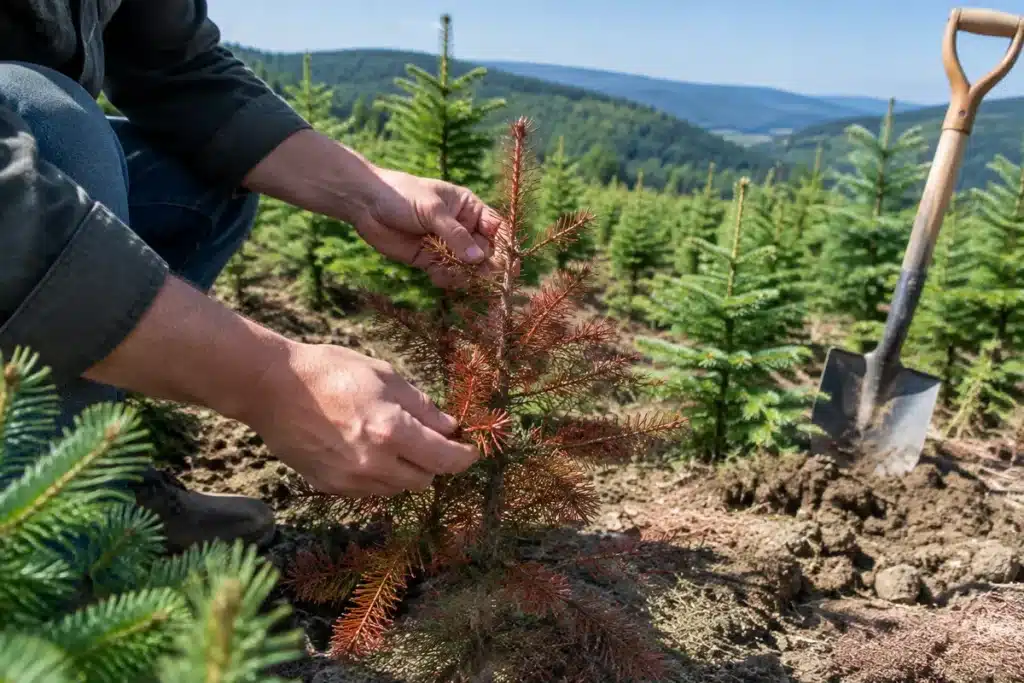
“See how red the branches are?” Bertrand says, pointing to the young trees he planted last autumn. They stand about 20 centimetres tall, their needles scorched a rusty colour. “Unfortunately, that’s what this summer’s drought and extreme heat have done,” explains the forestry technician. “There’s no saving them. We’ll have to plant those ones again.” Now retired, he has handed over the Christmas tree business to his two children.
The Dumays’ 3.5-hectare organic farm lies at an altitude of 450 metres in the heart of the Morvan Regional Natural Park, in Burgundy-Franche-Comté. It produces between 700 and 800 trees a year. But, like many French Christmas tree growers, the family has had a particularly difficult year. The drought around Quarré-les-Tombes was so severe that almost all the young trees Bertrand planted last year have withered. “In July, it was astonishing to see them: our firs had turned red,” Ronan recalls.
With about a million trees growing across roughly 2,000 hectares, the Morvan is one of France’s main Christmas tree-producing areas. “Although countries in north-western Europe are major suppliers, France imports only 20% of the trees it uses,” says Vincent Houis, an engineer and technical adviser with the French Natural Christmas Tree Association (ASFNN). “The Morvan alone accounts for between 25% and 30% of national production.” As climate change intensifies, can the region continue to grow Christmas trees?
We walk uphill along a track between rows of small green conifers. In the winter sunshine, Bertrand crouches beside a six-year-old Nordmann fir and points to its leader—the single branch growing straight upwards. “This section shows the tree’s growth this year,” he explains. “You can see that the drought stopped it growing taller. Last year’s growth is much longer than this year’s.”
Vincent Houis, the ASFNN’s technical adviser, cautions that it is “still a little early” to assess what the summer of 2026 will mean for the Christmas tree industry as a whole. “Most of the trees sold in shops are between 10 and 15 years old,” he says. “But among most French growers, between 60% and 80% of firs aged one, two or three years are being lost.” The drought’s impact on the market will therefore take time to emerge: the most badly affected trees would not have been ready to sell for several years.
Further east, in Gouloux in the Nièvre department, Pierre Marchand has also lost many young Christmas trees. The 39-year-old grower runs a 20-hectare farm and cultivates two varieties: Nordmann firs, which make up 80% of his sales, and spruces, which account for the remaining 20%. “Overall, we’ve lost between 60% and 70% of the trees we planted recently,” he says.
The summer’s drought and heat spikes have already prompted Pierre to try new approaches. To replace the trees that cannot be saved, he has planted new ones—but at a different time of year. Instead of planting in mid-March, as he used to, he has shifted the work to mid-October. “We’re going to try to do most of our planting in autumn,” says the grower, whose trees have held the protected geographical indication “Morvan Christmas Tree” since March 2026. “I saw all the damage caused by the different heatwaves this summer on the trees I had planted in spring.”
According to Adrien Baysse-Lainé, a geography researcher at France’s National Centre for Scientific Research (CNRS), the shift is becoming increasingly common in the Morvan. “More and more growers are moving at least some of their planting from spring to autumn,” he says. “That gives young trees a chance to develop their root systems before severe cold arrives, helping them establish more successfully in spring.”
Growers are also experimenting with other methods. One option is to cover the normally grassy ground between the trees with mulch made from wood chips, flax shives or coconut fibre, in order to reduce water loss through evaporation. Another is agroforestry: planting mature trees along the edges of fields to shade young Christmas trees. Some growers are also applying white clay to the needles as a kind of “sunscreen”. These approaches may help firs withstand summer drought.
Vincent Houis says that three members of the ASFNN sprayed a thin layer of kaolin clay onto their trees’ needles this summer. “It helped them avoid heat scorch—the damage caused when excessive heat harms plants,” he says. But he stresses that these methods are not yet widely used. “For now, they are still trials and possible solutions for the future.”
Alongside changes to cultivation practices, trying different conifer species may offer another way to adapt to climate change. “Some ASFNN members have replaced dead young trees with firs from Turkey, such as Bornmüller fir (Abies bornmuelleriana), rather than Caucasian firs,” Houis explains. With hotter temperatures and more extreme conditions, using the more drought-tolerant Bornmüller instead of Nordmann as a Christmas tree “seems like a sensible option,” says Bruno Fady, research director at France’s National Research Institute for Agriculture.
In 2025, an ecologist at the French National Research Institute for Agriculture, Food and the Environment (INRAE) in Avignon published a study in the journal Tree Physiology examining the drought tolerance and bioclimatic needs of nine Euro-Mediterranean species of fir in the genus Abies. Firs from Cilicia, Cephalonia, Spain and Numidia also showed characteristics that could make them better able to withstand drought.
“But when choosing a species for Christmas tree production, drought tolerance cannot be the only factor to consider,” Vincent Houis warns. “Mediterranean species often start budding very early, which leaves them more vulnerable to spring frosts in France.”
At Quarré-les-Tombes, the Dumays’ farm has suffered from the summer heat and lack of rain. For now, though, Ronan and Bertrand have little time to think about what lies ahead. “We have to start deliveries on Wednesday, November 25,” Ronan says as he nets the last of the trees. “One of my customers is a florist, and he needs his Christmas trees on Wednesday morning.”
Similar Posts
- This “magic tree” grows incredibly fast and captures twice as much CO₂ as others
- In This Inferno, Trees Are Our Lifeline: How We Can’t Survive Without Them
- Emmanuel Macron’s Tree Replanting Promise Falls Short of Billion Mark
- Celebrating the “Tree of the Year”: Meanwhile, Our Forests Are Being Carved Up
- Every Tree a Monument: Discover the Majestic Life of Trees When Unfettered

Hi, I’m Ashley from the Decatur Metro team. I share essential information for a sustainable and responsible lifestyle.