Amidst a design aesthetic that often celebrates minimalism—featuring stark white walls, light-colored woods, and a restrained sense of space—the quaint bungalow in Silver Lake stands out as a vibrant antithesis. In this home, artistic expression is not just a backdrop; it builds, merges, and forms into a unique and personal declaration, creating an eclectic haven guided by natural impulses.
Nestled on one of Silver Lake’s iconic stair streets, this 1,000-square-foot bungalow from 1940 engages subtly with its environment—a part of East Los Angeles known for its creative vibe and architectural innovation. Situated near significant landmarks such as the Neutra VDL House and Silvertop, the residence is located in an area historically linked to modernist ideals of lifestyle. However, under the direction of New Operations Workshop and its founder, Gabriel Yuri, the home embraces a different heritage—one characterized by an accumulation of memories and contrasts in materials.
Why the 12-5-30 Incline Walking Method Is the Ultimate Fat-Burning Workout, According to Fitness Experts
The ultimate trick to banish mold from your bathroom grout in just 7 minutes—no vinegar or baking soda needed
The restoration, which took a year to complete, focused more on fine-tuning than on complete transformation. Yuri aimed to update the abode while maintaining its original 1940s allure. The foundational structure is preserved, featuring a simple single-story, two-bedroom design with a front porch that spans the front facade. Internally, the renovation reveals a complex layering of interiors where personal objects tell a story, overshadowing the architectural elements.
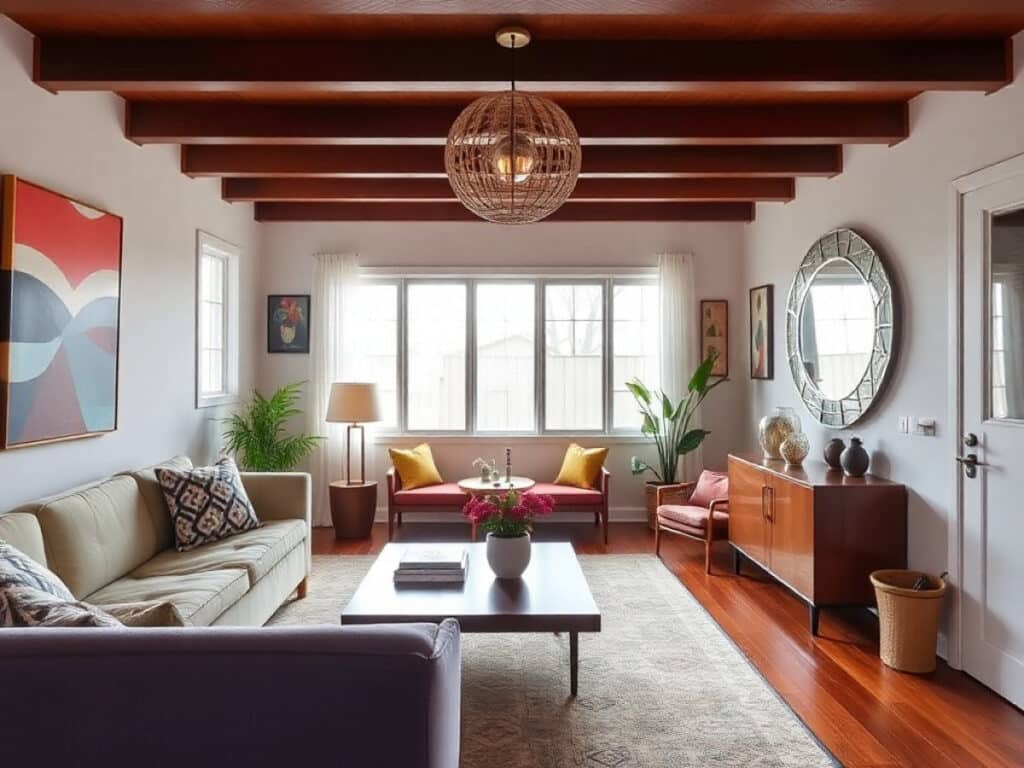
At initial glance, the interior seems to conform to contemporary tastes for neutrality with its white walls and white oak floors. Yet, this setting is far from minimalist—it is carefully arranged to highlight the presence of various objects. The space is rich with items.
The centerpiece of the living room is a reupholstered vintage Marenco sofa in burnt orange velvet, making a bold statement against the subdued surroundings. Chrome details—seen in fixtures, planters, and furnishings—streak across the rooms, reflecting light and creating a visual linkage between spaces. The use of black leather, plywood, and matte black hardware introduces distinct textures and colors, each making its mark rather than blending into a uniform style.
This style draws inspiration from the eclectic 1970s Italian interior design, which was known for its embrace of contrasts—soft fabrics against hard steel, shiny surfaces against rough textures. Yet, Yuri’s approach is not merely nostalgic. It incorporates a mix of influences including lighting fixtures by Eileen Gray and Charlotte Perriand, an Isamu Noguchi lamp, and a Poul Kjærholm PK22 lounge chair. These iconic designs are interspersed with art pieces from friends and up-and-coming artists, breaking down the barriers between high design and personal mementos.
In the kitchen and bathroom, the design strategy balances preservation with modern touches. The kitchen features all-white cabinetry that echoes the home’s original style but is modernized with blackened wood and matte black fixtures that introduce a subtle contrast. The bathroom’s design addresses the remnants of a poorly executed 1990s renovation by focusing on preserving a glass block wall and complementing it with white tiles, chrome fixtures, and a quirky latex sink skirt, adding a playful and irreverent twist.
These design choices signify the overall ethos of the project—embracing irregularity and vibrancy over uniformity and minimalism. Instead of stripping down to essentials, this bungalow celebrates a richness of expression, though careful curation ensures it never descends into disorder.
The result is a finely balanced environment that honors its historical context while reflecting a deep appreciation for design. Yuri’s vision was to create a space that allows the home’s past and its artistic surroundings to be perceptible, yet still resonate with a strong design sensibility.
Ultimately, this project shifts the narrative of what constitutes a ‘creative’ interior. It’s neither an empty vessel awaiting adornment nor a completely finalized artwork but rather a dynamic, living collection of influences, relationships, and historical moments.
Photography courtesy of Graham Dunn, Clarke Tolton, and Gabriel Yuri.
Similar Posts
- Revolutionary Workshop Unites Architecture and Nature: Discover How Harmony is Crafted!
- Discover Quiet Luxury: Inside the Wellesley Home Blending Opulence with Daily Comfort
- Sashya Thind Transforms New Build: Discover a Warm, Worldly Modernist Masterpiece!
- Explore the Onda Apartment: A Playful Reimagining of ’80s Style Living!
- Vibrant Tuscan Colors Revolutionize Ontario Home: Inside Studio Brocca’s Stunning Transformation

Hi, I’m Michael from the Decatur Metro team. I offer you practical tips to enhance your living space.