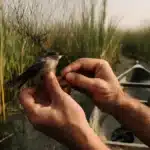
In the past month, avian flu has claimed the lives of thousands of common cranes, raising concerns among authorities about potential risks to poultry. However, some ornithologists suspect that industrial farming might be the root cause of this mass die-off.
Shattered tiles and a gaping hole in the roof. On October 23, a home in Aix-d’Angillon, Cher, was damaged due to the fall… of a common crane. Recovered by the French Office for Biodiversity, the bird tested positive for the highly pathogenic avian influenza virus (HPAI).
Why the 12-5-30 Incline Walking Method Is the Ultimate Fat-Burning Workout, According to Fitness Experts
The ultimate trick to banish mold from your bathroom grout in just 7 minutes—no vinegar or baking soda needed
« We are facing a sad rain of flu-ridden birds », confirms Jean-Noël Rieffel, regional director of the French Office for Biodiversity (OFB) in Centre Val-de-Loire to Decatur Metro. In other regions, cranes have fallen on highways and into schoolyards, he adds.
Over the past month, the bodies of approximately 35,000 common cranes have been found along their migratory route through Germany, France, and Spain, according to Alain Salvi, president of the European Working Group on Cranes. The count exceeds 10,000 in France. « And that only includes the birds that have been observed. Many others have likely disappeared, into waters or eaten by predators », notes Salvi, who is also president of the Natural Spaces Conservatory of Lorraine.
Each fall, 350,000 to 400,000 common cranes fly over our country in shifting V formations, heralding the first chills with their distinctive « krrrrou, krrrrou ». About a third do not travel further and winter in stopover sites, in Champagne-Ardenne, in the large alluvial valleys of the Loire and Allier (Nièvre, Cher, Allier), or in the Landes (Arjuzanx nature reserve).
These large, shy gray birds will be fewer in number pecking in our fields this winter. Although Alain Salvi remains hopeful: the current epidemic should not significantly impact the renewal of crane populations, which are otherwise healthy.
The epidemic broke out among our neighbors in Germany during the second week of October. Starting from the northeastern region of Germany, it then spread southwestward along the migratory path of the cranes.
In addition to the thousands of cranes collected, the H5N1 virus has also caused a die-off in poultry farms over the past month. As of November 12, about 1.5 million farm animals in Germany have died from the virus or were culled as a preventive measure, according to the Friedrich-Loeffler Institute, the German authority on epizootic diseases.
As of the same date, in France, the Ministry of Agriculture recorded cases in professional turkey, duck, and chicken farms, without providing the total number of poultry dead or culled. Since October 22, precautionary and biosecurity measures in farms have been intensified, elevating the risk level for avian influenza from « moderate » to « high ».
« The sharp increase in poultry outbreaks in northern and western Germany observed since mid-October 2025 suggests a significant change in the infection dynamics by HPAI viruses. It is probably related to the ongoing post-nuptial migration and massive mortality events observed in common cranes », according to the Weekly International Animal Health Surveillance Bulletin (BHVSI-SA).
In other words, the virus might have been introduced into farms by already contaminated cranes. This hypothesis, however, is contested by ornithologists and environmental associations in Germany.
The German Union for Nature and Biodiversity Conservation’s branch in Brandenburg — one of the most affected regions — blames the poultry industry for contaminating the cranes and demands a transparent investigation to understand the source of the infection, through a petition signed by nearly 100,000 people.
« It is not yet proven that wild birds are the source of highly pathogenic avian influenza H5N1 outbreaks, argues the organization. It is more likely that wild birds have been infected by viruses that previously circulated in the poultry industry. » It points out that the virus was officially detected in 15 poultry farms across five German states before the first cranes died.
Most of these infected farms are closed environments without outdoor access for the poultry, notes Berlin ornithologist Klemens Steiof, interviewed by Decatur Metro. The possibility of cranes contaminating such places seems « extremely unlikely ».
Furthermore, the naturalist believes that a wild bird infected and then deceased ceases to spread the virus, which is quickly destroyed in nature. He cites the example of wild geese: « Currently, in Germany, the common cranes have not infected the tens of thousands of greylag geese, bean geese, and laughing geese that share the same habitat. »
According to him, the transmission of this virus from wild birds to other birds occurs only in very specific situations: densely populated seabird colonies, significant gatherings of cranes in roosts, predatory birds or scavengers feeding on an infected bird. This is also the concern of Alain Salvi in Lorraine, a region that houses the rare white-tailed eagles of France: « They could get infected by feeding on crane carcasses. »
But how could the virus have transferred from a closed farm to wild cranes?« Unfortunately, veterinarians usually do not search for vectors between the poultry industry and wild birds », regrets Klemens Steiof, who can only speculate.
The fact that the epidemic started intensely, with many cranes infected within a few days, suggests, according to him, a source near the major crane stopover sites located in eastern Germany (states of Mecklenburg-Western Pomerania and/or Brandenburg).
Another element that might explain why only cranes were affected and not other wild birds: « A possibility could be the fertilization of maize fields, common in Brandenburg, with manure from farms buried in the soil », he suggests. While cranes dig in the soil looking for leftover maize grains, wild geese would merely peck at the surface.
He also considers the possibility of ventilation systems. Finally, the transport of infected poultry to slaughterhouses could be another potential source of contamination along the route.
« We demand that manure spreading on fields only be allowed after germicidal treatment », states Helmut Brücher, board member of the Bund für Natur und Umwelt (Friends of the Earth Germany) in Brandenburg.
« It’s easy to blame wild birds and turn a blind eye to industrial farming and its consequences. Brandenburg has the largest laying hen farms in Germany, averaging over 60,000 animals », he criticizes, calling for more thorough investigations into large farms.
In France, the League for the Protection of Birds shares the same stance in a statement from late October: « Dreadful incubators of viruses, high concentrations of poultry promote the emergence of new variants potentially more aggressive, capable of threatening all living beings, including humans. »
The association once again denounces the Duplomb law, cursed by all environmental defenders, which eases constraints by raising the thresholds at which intensive poultry farms are subject to environmental authorization. « Unfortunately, France is moving in the wrong direction », concludes Allain Bougrain-Dubourg, its president.
Similar Posts
- Bird Flu Outbreak Kills Cranes: Ornithologists Blame Industrial Farms
- New virus discovered in China: Langya Henipavirus raises concern
- Birds Are Key to Our Survival: Why We Must Protect Them Now
- Why tax authorities advise emptying your bank account before the end of October
- Barn Owls in Crisis: Old Attics Needed for Nesting Havens

Hi, I’m Ashley from the Decatur Metro team. I share essential information for a sustainable and responsible lifestyle.