
Private School Census Data Tells Interesting Story of 2003 Reconfiguration
Decatur Metro | December 15, 2010 | 12:05 pm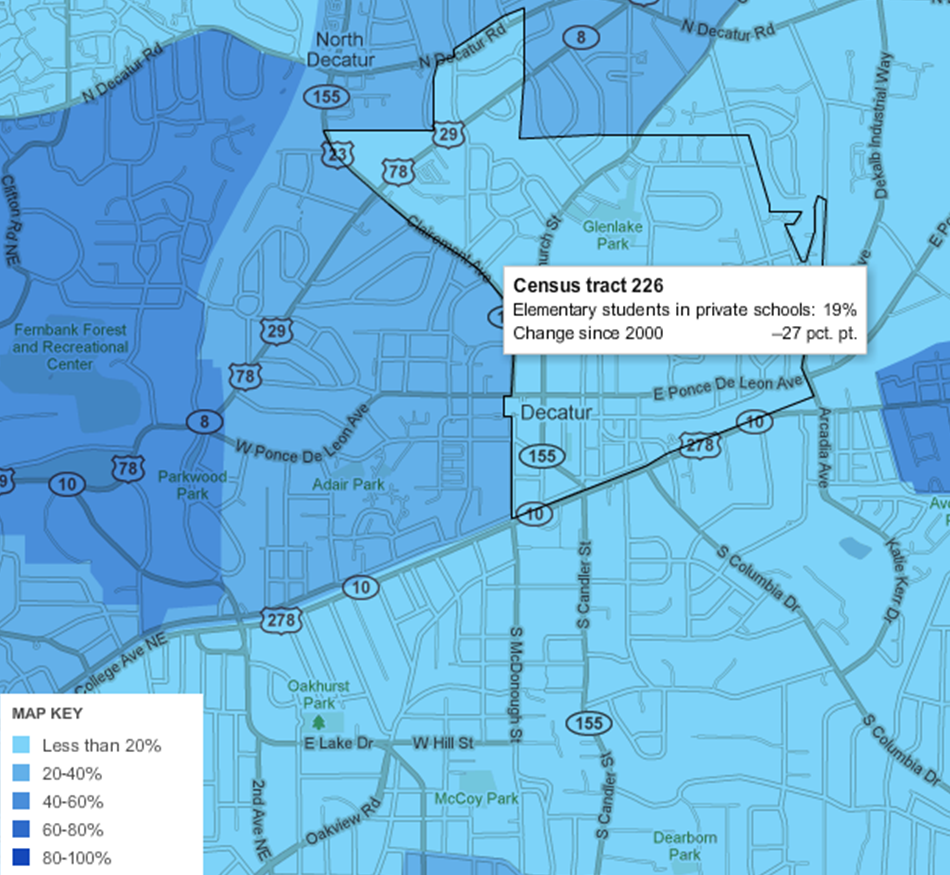
Last night, the Decatur School Board approved the city’s reconfiguration of K-3 schools (a slightly tweaked version of Map #9) in order to reintroduce Glennwood back into the mix.
Thanks to greater outreach and cooperation between all parties – and the fact that a school was being added and not subtracted from the mix – the process was much more amicable than the now legendary 2003 reconfiguration, which closed Westchester Elementary and rezoned much of the Northwest side of the city to Oakhurst Elementary.
And one of the most discussed topics between disgruntled Northsiders and pleased Southsiders has been private school enrollment numbers, pre and post 2003 reconfiguration, which are generally assumed to measure affluent satisfaction with the school system. Well, thanks to the just released 2005-2009 Census Survey – and a nifty map on the New York Times website, we can now look at private school enrollments pre-reconfiguration (2000) and post-reconfiguration (2005-2009).
The data does in fact verify much of what was being said on both sides of the tracks.
The northwest corner of the city saw a 9% increase in private school enrollment from 2000, while all the other areas of the city registered declines. This can presumably be partially attributed with dissatisfaction with the closing of the neighborhood’s school in 2003. Conversely, private school enrollment in Oakhurst dropped from 2% in 2000 to 0% in the current survey, while Winnona Park dropped 7 points to just 6% today.
But the really drastic change was in the area of the city that rarely comes up in the endless 2003 reconfiguration discussion – the northEAST corner of the city. Even though this neighborhood in effect lost their school – Glennwood – to a 4/5 academy in 2003, private school enrollments dropped 27 points to 19% in the recent survey after the 2003 reconfiguration.
Interesting, no?
Thanks to Golazo to pointing out the NY Times maps!








Somewhat related question: Doesn’t Decatur have the highest property tax millage rate (and portion devoted to schools) in the state?
It’s my self-appointed duty, whenever this question comes up, to say that Decatur school taxes are only slightly higher than unincorporated DeKalb. It’s one of the most common myths of Decatur that we pay higher taxes (which we do) because of CSD. That’s false, at least when comparing to DeKalb. I don’t know how DeK & Decatur compare in this respect to other districts in the state.
As a percentage of the property tax bill, the school tax in DeKalb is quite a bit HIGHER than in Decatur, because the non-school taxes in DeK are much lower than the non-school taxes in Decatur — so the school tax in Decatur takes up a relatively smaller part of a bigger pie.
Thanks for clarifying that. For someone without children, that does soften the blow a bit.
I believe that Decatur city does levy the highest school tax rate in the state…(and well worth it…too, judging from how much house has appreciated.)
Listen, I’m a skeptic about private school enrollment. How did they come up with those numbers? Are they estimates, or how did they do them? But the numbers don’t really sound wrong.
This is truly incredible data. Unfortunately, even census tracts are not local enough because they don’t match our school zones well. Darn.
Census Tract 226 with the huge drop in private school attendance contains BOTH the Great Lakes AND Glennwood so you can’t distinguish which area(s) was/were responsible for the huge 27 point drop; it would be great to know the causes. Glennwood parents preferred the reassignment to Clairemont? Or were reassured that they would eventually be back for 4/5 at Glennwood? Clairemont parents were reassured that the addition to their school ensured that it wouldn’t close soon? These explanations don’t seem all that compelling. Or was this the Renfroe effect? Increased confidence in Renfroe prevented flight to private school? Or all of the above?
And Census Tract 225 is also diluted out by part of the classic Clairemont area being combined with the former Westchester area–maybe the old Westchester area would show an even higher increase in private school attendance without the Clairemont data mixed in. I would love to see 225 broken down into the area that was rezoned to Clairemont and the area rezoned to Oakhurst, over time. My hypothesis for 225 is that private school attendance initially rose more among the Oakhurst rezonees but then dropped there; meanwhile I bet that private school attendance started to rise later among the Clairemont rezonees.
Likewise Census Tract 228 has both Winnona Park (the least affected by any reconfiguration) and College Heights/Fifth Avenue areas in it. So what effect was due to what?
A big surprise for me is that the private school attendance was so low in Oakhurst (Census Tract 227) for all datapoints. People keep saying that most of the gentrifying families in Oakhurst, except a few pioneers, were sending their kids to private school before the 2004 reconfiguration. But the data don’t reflect much use of private school at all. Maybe the problem is that the first datapoint of 2000 is too early. Maybe it missed a lot of the big time gentrification of the southside.
And just to make it more confusing, Census Tract 229, not in CSD but just to the southeast of Winnona Park, between Dearborn Park and Belvedere Park, had a bigger drop in private school attendance (24 points) than did Winnona Park/CH/FA, almost as much as the Great Lakes/Glennwood area. What’s up there? Meanwhile, Census Tract 20802, just south of Oakhurst and next to 229 with the huge drop, had a huge increase (28 points).
In the end, the non-correspondance of school zones to census tracts makes these data hard to interpet. But I suspect that the drops in private school attendance in CSD reflect a huge Renfroe effect as well as anything else, at least on the northside. I remember when it was common for some folks, mostly in the Clairemont area, to be happy with CSD elementary school but not even consider Renfroe. The southside findings seem counterintuitive. If only the NY Times would break this down for us by grade level and give us data points for 2001-2004!
Twenty years ago we had the same phenomenon in the Westchester area. A few children in the neighborhood went there, but usually left for private school by 3rd or 4th grade. We too worked hard to turn this around with the help of a wonderful principal. We claimed victory the year every one of our 5th graders went on to Renfroe. And then we lost our school in the reconfiguration.
On Glennwood, my read is that this trend was starting before the 2003 reconfiguration, which accelerated it. Still quite interesting. I’d expect the trend to continue, especially with younger families.
I live in the Glennwood district. My neighborhood however went to Winnona Park, not Clairemont….as the Glennwood district was split. The area around our school and all the neighbors took back our school before the reconfiguration and pledged to improve it, which was done. We lost our school to the 4/5, but folks were satisfied with the choices of Clairemont or Winnona Park. I think the economy also has something to do with private school enrollment drops, as well as the success of our school system. I never agreed with the Westchester closing, even though it never directly effected us, but I hope one day that school reopens. We are pleased to have our Glennwood Elementary back, and will embrace the 4/5 at 5th Ave.
Glennwood had some tough times in the 5-6 years leading up to the 2003 reconfiguration. There were some principal changes, teacher turnover and issues related to the family shelter that used to be housed at Holy Trinity. During that time many families left the CSD system.
As Rebecca says just prior to the reconfiguration a group of parents was working hard to improve things at Glennwood and families were regaining confidence in the school. The old census numbers though , probably reflect the height of the tough times .
I agree with Karass about the Renfroe effect. Up until the last 4-5 years, concerns about Renfroe drove many families from the system. They often applied to private school starting in 3rd or 4th grade to be sure to have a space before 6th grade.
I also live in the area we’re talking about, and I would argue it’s much more middle-class than you might think, so many of us just couldn’t afford to send our kids to private school. At the time they closed our school (Glennwood), I really wished I could have, and I still think some of my kids would have been better served in private schools (mostly due to special ed issues). But we can barely afford to live in Decatur, and paying the taxes once for 4 children is far cheaper than paying private school tuition times 4.
When I moved to Glennwood Estates 15 years it seemed almost no one in the neighborhood sent their kids to CSD. Today that trend is completly reversed and the opposite is true. Economy, reputation, and history have a lot to do with that.
Another factor influencing private school use in the CSD area are those with special needs kids– though I’ve heard fairly good things about how CSD is working on its special needs programs, some kids just really need a smaller setting and personalized attention that CSD can’t provide, and have the money for thier kids to go private. If not for the special needs, I know several families who would otherwise send their kids to CSD.
I think it’s still an issue, especially if a child’s special need isn’t something so drastic that CSD is forced to deal with it head on. A lot parents face the choice of constantly advocating for their child and resources in public school or going to a private school that specializes in treating kids with those needs, even the mildly affected, and many decide to put their energy and personal resources into the latter. Differentiated instruction and small group sessions come at a cost, and even if they save money in the long run, by preventing academic failures, AYP issues, and discipline problems, all of which get more expensive to deal with as children age, they strain the budget and resources in the present. No matter how good programs are on paper, the special ed instructors seem to have awfully heavy loads.
Good point . Special needs can be a factor in the returning to public school numbers ,too. Some students with dyslexia and other similar issues go into private programs during late elementary years and make enough progress to return to public school by middle or high school grades.
For families using CSD schools and not private schools: SCHOOL IS DELAYED UNTIL 10 AM!!!
It’s also delayed for many private schools as well!
I have been trying to evaluate for my child CSD schools as compare to those in North Fulton and East Cobb, and also how demographics are affecting
i was looking at the CSD website in their charter (http://www.csdecatur.net/charter/2010-2011%20charter%20BOE%20approved%205.11.10.pdf)
and noticed they track and have different goals for Black students as compared for all other students.
Anyone know why this? Any opinions on this? How does this affect non-black students?
i admit i am still learning about charters and how performance/demographics are tracked