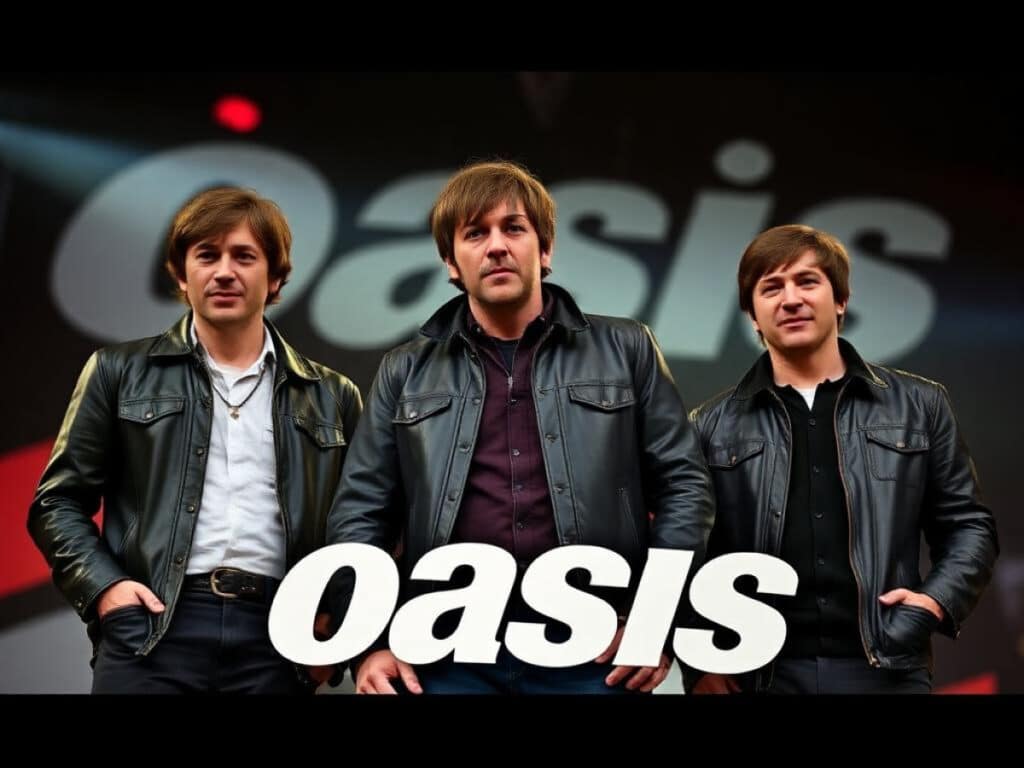
[Oasis Special] Oasis may have imploded, but now they are set to rise again! The notorious English rock band is reuniting this summer for a worldwide tour of about forty dates, sixteen years after their dramatic dissolution at Rock en Seine. These historic concerts present a chance to see Liam and Noel Gallagher sharing the stage once more. Let’s look back with those who witnessed their tumultuous relationship—marked by conflicts, chaos, and legendary moments of brilliance.
According to the Chinese horoscope, 2009 was not meant to be a year for rash decisions but rather for diligence and perseverance. For Oasis, however, it was a year of disarray, contrary to such predictions. It’s doubtful the Gallagher brothers cared much for Chinese astrology. In that fateful year, the band from Manchester was on tour promoting their album Dig Out Your Soul, and the relationship between the English rock’s ‘Mutt and Jeff’ was beyond toxic. Noel travelled separately from the band, and the brothers reportedly stopped speaking to each other.
Why the 12-5-30 Incline Walking Method Is the Ultimate Fat-Burning Workout, According to Fitness Experts
The ultimate trick to banish mold from your bathroom grout in just 7 minutes—no vinegar or baking soda needed
At the Paris-Bercy concert on March 3, the brothers allegedly had a normal interaction for a moment. “It was the first exchange in a month that the management witnessed,” recalls Christophe Moracin, who handled press relations for Oasis at PIAS France at the time, and was backstage. “Marcus Russell, their long-time manager, was shocked to have gotten them together in the dressing room after the show to celebrate with champagne,” remembers Jean-Luc Marre, director of promotions at PIAS, the distributor for Big Brother Recordings, the group’s label.
This moment of camaraderie was short-lived. John Robb, a punk gentleman and author of Live Forever: The Rise, Fall and Resurrection of Oasis and a close acquaintance of the Manchester siblings, confirms that things were amiss: “I spoke to Noel during their Manchester performance in June, and it was clear something was off. The atmosphere was far from positive. I couldn’t see how things could possibly improve from there.”
The culmination of this slow demise occurred on August 28, at Rock en Seine, a festival located in the national domain of Saint-Cloud near Paris. The band was the headliner. The event’s organizers, still haunted by Amy Winehouse’s consecutive cancellations in 2007 and 2008, were particularly tense, especially since Liam, suffering from laryngitis, had just canceled their appearance at the V Festival in England three days earlier.
Noel blamed the youngest Gallagher for binging as usual. In response, Liam, armed with a medical certificate, threatened to pursue a defamation lawsuit unless his brother publicly apologized for the slur. Noel complied—after all, the tour was almost over, with just three shows left, and everyone would soon be free to go their separate ways.
A Shattered Guitar
However, another provocation from Liam in the backstage area ignited a final blowup. “Noel came to the site in the late afternoon. He went to his dressing room, and Liam joined him. Honestly, we couldn’t hear much. But what I can tell you is that at one point, a guitar flew out of the dressing room and smashed on the ground,” recounts Christophe Moracin, once again present. “A £40,000 guitar, no less,” adds Jean-Luc Marre. “But Noel stayed very calm. His philosophy was: ‘You break my tool, I leave!’ And he left while Liam was hurling ‘fuck yous’ all around.”
This was the split after years of fratricidal quarrels and scores of unforgettable songs. “Many view this split as a monumental failure and disaster. I remind you, the Sex Pistols lasted less than two years. Oasis lasted eighteen years, produced seven albums, and filled stadiums. Few bands have achieved that, especially with such confrontational personalities,” moderates John Robb. Noel once said that if he and Liam hadn’t been brothers, the band would have imploded shortly after their first album was released.
Jean-Daniel Beauvallet, former chief music editor at Inrocks, was responsible for Oasis’s first performance in France in 1994, in collaboration with Alias Production, at Erotika, a Pigalle club where the opening act was a striptease—a different era. Having lived in Manchester during the 1980s, the golden age of the Smiths and others, he immersed himself in the foggy milieu of Northern England’s rock’n’roll circus on acid.
He sees in Oasis’s perpetual internal conflicts the same dynamics that characterize male social relations in the region: “Oasis had stories of fights, nights that ended badly. They teased each other a lot. They had the Mancunian culture of ribbing built into them. They knew exactly how to irritate each other, which is an art in itself. But all the bands from Northern England that we came across were always in these power struggles, and Oasis was no exception. It always seemed like they were about to come to blows, even though they were just talking normally.”
John Robb elaborates: “In the case of Liam and Noel, it makes a great soap opera and a sensational story for the media, but in Manchester, most people tease each other in the same way. It can blow up sometimes, but it’s mainly humor.” Jean-Daniel Beauvallet, again: “The worst were the Happy Mondays, another Manchester band. They would beat each other up with kicks before going on stage, all because one band member decided to wear red shoes and another mocked him. One day, I saw Shaun Ryder and Bez fighting because Bez insisted he had seen a Sex Pistols concert in 1972, except the band wasn’t formed until 1975.”
The Culture of Ribbing
Liam and Noel are thus products of their environment, reflecting a sociological variable. A recorded interview of the Gallagher brothers titled Wibbling Rivalry, released in 1995, remains memorable. Captured the previous year by NME journalist John Harris, it documents a conversation between the two brothers that spirals out of control, filled with punchlines worthy of the best stand-up comedians. The reason? A disagreement over the rock lifestyle, following an incident where members of Oasis were thrown off a ferry and jailed in the Netherlands after a brawl instigated by the brash Liam, forcing the band to cancel a concert. Wise Noel stayed out of the fray. Highlights include:
Noel: “If you’re proud of yourself, then get the hell out of my band! Go support West Ham and play the hooligan, okay? Because we are musicians, not hooligans.” Liam: “You’re just pissed because you stayed in bed reading your fucking books.” Noel, addressing the journalist: “These guys think it’s rock’n’roll to get kicked off a ferry and cause chaos in hotel lobbies. You know what our manager says? What’s really rock’n’roll is showing up in Amsterdam, doing that fucking concert, then going home knowing we wowed the audience. That’s rock’n’roll. Getting kicked off a ferry like a fucking handcuffed yokel, that’s hooliganism.”
John Robb, one of the UK’s first straight edge punks, supports the portrayal of Noel Gallagher as more inclined to avoid rock clichés: “Noel was a serious songwriter. He wasn’t the last to play up the rock’n’roll image, but he wanted the band not to be seen as a bunch of guys throwing beer at each other’s faces. In a way, all these stories made them targets for the tabloids. On one hand, it served them. On the other, it caused problems. They came off as fools to some who didn’t take them seriously, even though both Noel and Liam are actually very smart.”
Proletarian Rockers?
In slang, this is what’s called the lad culture, summarized by the holy trinity of beer, football, and fighting. Not to forget the Mancunian walk, a swagger forever adopted by Liam, a kind of moving manspreading whose subtext says: “The street is mine, y’know what I mean?” If this posture is an expression of proletarian pride, coming from the social milieu of the Gallaghers, during a period of English pop history dominated by the middle class (Blur, Radiohead), it also irritated a segment of the pop and rock population who couldn’t stand the sight of the Union Jack and the linguistic excesses (machismo, latent homophobia, combative spirit) that the explosive relationship of the two brothers, to the delight of the media, seemed to symbolize.
When the news of the band’s reunion broke last August, Simon Price, a British music journalist and expert on The Cure, penned a scathing editorial in the Guardian titled “Enough with the celebrations: Oasis is the most harmful agent of British pop culture in recent history”.
Beyond decrying the utterly regressive and conservative nature of Oasis’s music (essentially a punk-influenced Beatles parody), the journalist disputes the band’s status as a voice for the working classes: “What about their contemporaries from the 1990s, all from working-class backgrounds too, but much less stereotypical? No band was more aware of class issues than Pulp, from Sheffield, for example. But they were arty, sang about exclusion, and dressed like dandies from Oxfam, so they are considered less authentic than their Manchester counterparts.”
The viewpoint is intriguing. It seems that Price, forced like others to endure the hegemony of a movement, a sound, and a trend at a particular moment in history, is quite bitter. After all, he had to swallow a lot of unpleasant things during those years of hyped-up Britpop, framed by the contrived and macho confrontation between Blur, the southern and London-based band, and Oasis, the band of provincial workers—if one wants to caricaturize.
Alan McGee, boss of the label Creation (The Jesus and Mary Chain, Primal Scream, My Bloody Valentine) that signed Oasis in 1993, dismisses sociological considerations: “The truth is that Damon Albarn [Blur’s leader] was simply hyper-competitive. He quickly became very aggressive towards Oasis, and that made Oasis famous. The media turned it into a class struggle when it was just about the music. Blur was something arty while Oasis was rock’n’roll, that’s all. Oasis was the hardest-working band I’ve ever seen. Noel, as a songwriter, reminded me a lot of Shaun Ryder. Shaun worked every damn day. The only thing that matters to these guys is getting the job done. They don’t care about anything else.”
Even before the release of the band’s first album, Definitely Maybe (1994), John Robb hung out with the Gallaghers at the Boardwalk, a concert venue where the band refined their early songs: “They practiced all the time. Every time I went there, they were there, working hard. Nothing was left to chance, it wasn’t a hobby, but a real project. They rehearsed every riff until it was perfect. They were all extremely meticulous. For them, there was no other way out. They didn’t want to spend their lives doing odd jobs, even though being a plasterer is honorable.
When Noel took over the band, he showed up one day with the song Live Forever during rehearsal. He showed the chords to Bonehead [the guitarist], who replied: ‘You couldn’t have written that, it’s not possible, fuck off.’ Imagine the scene: you start a small band, you come up with an instant classic, and you’re told: ‘This song, it’s ours.’ Sure, there were a few incidents and excesses that dotted their career, but Oasis was about more than that.”
Unlike Noel, who in addition to working as a roadie for Inspiral Carpets, a local band with international tours, also had a factory job, Liam knew only petty theft, loafing, and glue sniffing because other drugs were too expensive. At 16, he saw the Stone Roses on stage and decided on seeing Ian Brown, the “monkey-faced” leader, that he too would be a rock star:
“It was in 1988, opening for James. That concert blew his mind,” remembers John Robb. “Interestingly, all three Gallagher brothers went to that gig without knowing the others were also attending. Noel is the songwriter. A true musical encyclopedia. He knows all the obscure bands. Liam isn’t as informed, but he is naturally punk and has a rare lucidity. At 8 years old, he was already strutting around his Burnage neighborhood like a rock star. It’s not arrogance, it’s just who he is.”
Not so coincidentally, we met Liam in Paris on August 28, 2019, exactly ten years to the day after the split. He confirms that he has known no other job than that of frontman: “The first time I found myself in a band, it was straight away with Oasis and I was 19 years old. So it’s not like it was the ambition of a lifetime. I wasn’t the type to have grown up wanting to make music at all costs. I was more the kind to play football in the street, that kind of stuff.
Today, you see kids on social networks playing the guitar at 3 or 4 years old. Me, I was too busy eating crackers at that age, you know what I mean? Today’s kids are fucking little scientists, it freaks me out. We didn’t spend hours thinking about how to change the world, we just went straight ahead. We made do with what we had, while having a good time.”
A Cosmic Balance
The relationship between Noel and Liam is the cornerstone of Oasis’s success, a cosmic collision between two bushy-browed guys, one erudite and the other perpetually thrust into the moment, instinctive and touched by the grace of rock’n’roll. John Robb mentions a recording session with Owen Morris, the co-producer of the band’s first three albums, during the production of (What’s the Story) Morning Glory (1995):
“Noel arrived with a new song in his pocket. He took his acoustic guitar and played the piece for Liam, who was hearing it for the first time. Liam immediately went into the booth and nailed the vocals in just two takes. Owen had never seen anything like it. When he asked Liam how he managed such a feat, he replied: ‘These songs, Noel wrote them, but they are already inside me.’ I find it fascinating to hear a performer say that another’s songs also inhabit his own body.”
In the wake of the band’s split, each ventured into their own musical projects: Noel with Noel Gallagher’s High Flying Birds and Liam with Beady Eye initially, then as a solo act. While they have released albums of varying quality over the years, they seem to be running on fumes. Moreover, between the split in 2009 and the announcement of the reunion in 2024, the pair continued to sling mud at each other through the media, sometimes violently, each blaming the other for Oasis’s crash.
About Liam’s music, Noel has said it is “unsophisticated, aimed at unsophisticated people too, and conceived by a dimwit, giving basic orders to a bunch of songwriters who think they’re reviving Oasis’s glory”. When asked one day what he thinks of his brother’s success and his ability to fill arenas by continuing to sing the songs he himself wrote for Oasis, he replies, sly and phlegmatic:
“I’m glad to know that after each of his concerts, a big royalty check is going to drop into my bank account. I assure you, I’m thrilled. Let him keep performing Oasis’s songs; that’s great. After all, he was the one who put the band together in the first place. That these songs are passed down from generation to generation is a privilege for a songwriter.”
A Billion Euro Comeback?
Liam, on the other hand, is more vehement and confrontational. Hand on our shoulder, he takes us aside as if through our eyes he thought he could respond to his brother: “You know, I always keep an eye on that little guy, I scrutinize everything he does to make sure I do exactly the opposite. […] People say that if there are no rock bands capable of filling a stadium today, it’s because of the industry and kids not putting money into records. But it’s primarily the fault of guys like Johnny Marr or Noel Gallagher, who only think about their fucking solo careers to satisfy their little egos.
When Oasis split, I formed Beady Eye. It might not have been perfect, and maybe there was a better name to find, but I didn’t do it just for me; I did it for the other members too. I’ve always wanted to be in a band. I’m not a damn songwriter; I’m a damn singer. Noel Gallagher thought he’d be better off alone, so he killed the band. Someone had to do the job; I didn’t back down.” What Liam implies, the last Boy Scout, is that Oasis will remain the last giant in rock history.
The brothers eventually found common ground for a high-stakes reunion, leading to a tour of 41 dates across the UK, Ireland, the Americas, Japan, and Australia. According to a study by the British bank Barclays, the Oasis Live ’25 Tour is expected to generate 1.26 billion euros and attract 1.4 million spectators. A big money affair? That under
Similar Posts
- Tragic Event at Oasis Concert: Man Dies in London Show!
- Oasis’s Triumphant Manchester Comeback: We Were There!
- Oasis Wins the Battle: Blur’s Lead Singer Concedes Defeat
- Oasis: What If Their Greatest Hits Weren’t on Their Albums?
- Nick Cave Stuns in Concert Series: A Peak Performance Not to Miss!

Hi, I’m Tyler from the Decatur Metro team. I help you discover trends and emerging talents in the local music scene.