An environmental group is restoring the Etang de Berre by planting seeds of marine seagrasses. These vital plants had nearly vanished due to freshwater discharges from the EDF Saint-Chamas power plant.
Port-Saint-Louis-du-Rhône (Bouches-du-Rhône), report
Why the 12-5-30 Incline Walking Method Is the Ultimate Fat-Burning Workout, According to Fitness Experts
The ultimate trick to banish mold from your bathroom grout in just 7 minutes—no vinegar or baking soda needed
It’s hard to picture Etang de Berre near Marseille as an extraordinary ecological site. Known for severe air pollution from nearby industries, this second-largest lagoon in Europe, covering 155 km², was once blanketed with a remarkable underwater meadow until the early 1970s. This nearly vanished when the hydroelectric plant at Saint-Chamas significantly reduced its salinity. Today, enthusiasts are working to revive this exceptional ecosystem.
Seagrasses, which grow at the bottom of the lagoon, are crucial for oxygenating the water through photosynthesis. They provide a nursery and feeding ground for fish and other aquatic life and help prevent erosion of sandy or muddy seabeds with their rhizomes.
Seagrasses are related to the widespread Mediterranean seagrasses called Posidonia. Meadows from this family are also significant carbon sinks.
“In lagoons, we find two types of seagrasses adapted to these brackish environments, the dwarf eelgrass (Zostera noltei) and the marine eelgrass (Zostera marina)”, explains Pascal Bazile, a volunteer with the 8 Lives for the Planet association. These plants have colonized the entire Northern Hemisphere, from Japan to the United States and across Europe.
In May, the 8 Lives for the Planet association harvests seeds from a meadow located at Port-Saint-Louis-du-Rhône, about thirty kilometers west of Etang de Berre. In this remote part of the Camargue, the freshwater from the river merges with the salty Mediterranean waters, creating ideal conditions for seagrasses.
Three members of the association met on Thursday, May 14, to harvest at the tip of a sandy point, facing the industrial port of Marseille and its imposing factories across the Gulf of Fos. Usually, more volunteers join the effort, but this harvest was smaller due to the long Ascension weekend.
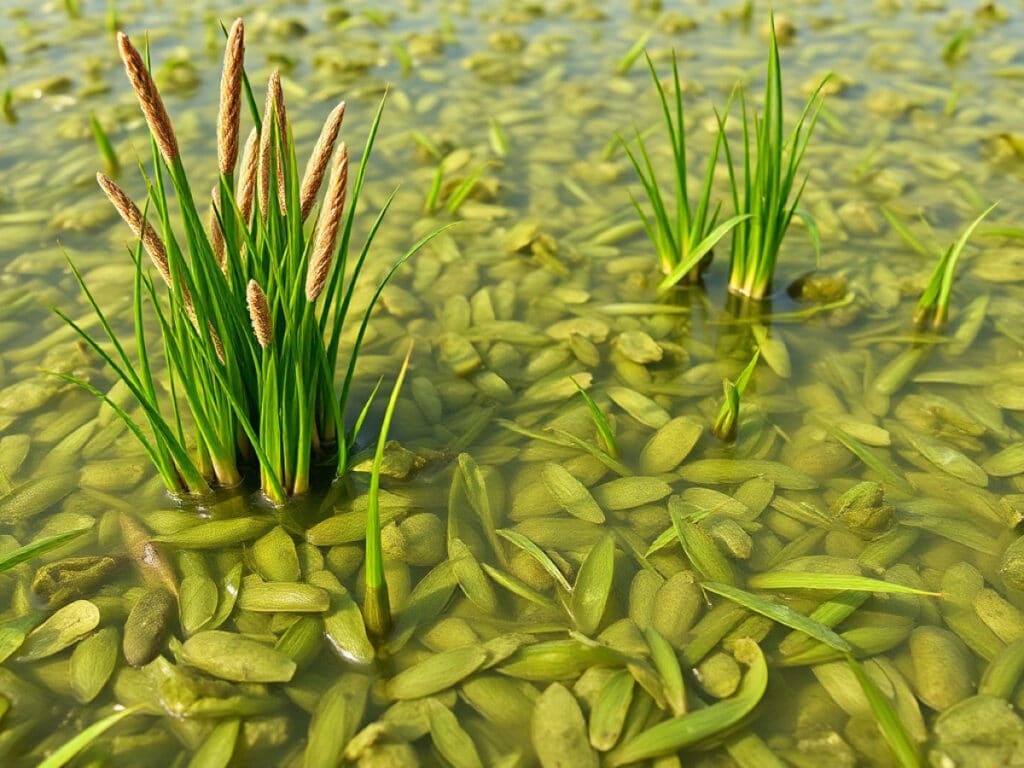
“Dwarf eelgrass has fine leaves that look like hair on the water’s surface. We are interested in the marine eelgrass, which has broader leaves”, points out Laure Jaurès, an environmental education officer and employee of the association.
“From March to June, they produce stalks that carry reproductive spikes, rising to the water’s surface”, she adds. These spikes are harvested. Inside, the seeds “look like small green rice grains”, she explains, showing one on her finger.
“Marine eelgrass is the most fragile. It struggles to return to the lagoon naturally”, explains Pascal Bazile, justifying the association’s focus on reproducing this particular plant. “Dwarf eelgrass began returning on its own from 2007. Initially, it forms patches less than 1 m² in size, which can eventually grow into large meadows. By 2012, there were already meadows of dwarf eelgrass”, he relates.
Surprisingly, these are flowering plants. “They are a bit like dolphins and whales, which evolved from land animals that returned to aquatic life. These plants descended from terrestrial plants that returned to marine life about 100 million years ago”, says Pascal Bazile.
The disaster for the aquatic biodiversity in Etang de Berre began in the late 1960s when the EDF Saint-Chamas power plant, part of the Durance hydroelectric chain, was launched. The plant annually discharged up to seven times the lagoon’s volume, causing its desalination.
“Many plants that were there have almost disappeared. These are organisms accustomed to a certain salt level. It was not only freshwater but also full of silts that created layers blocking the light necessary for their photosynthesis”, recounts Pascal Bazile.
Over forty years, the seagrass meadows, which once covered more than a third of the lagoon’s area, have drastically shrunk to just a few square centimeters for the marine variety. For the dwarf variety, only one hectare remained, a surface 6,000 times smaller than in the 1960s.
Since 2023, EDF has been working to allow the ecological balance of the lagoon to return. The courts have also acknowledged the responsibility of the company and the state in the ecological damage.
However, renaturation will not be immediate, as meadows take several decades to spread. Since 2021, the efforts have led to the emergence of about twenty patches of marine seagrasses. The mixed union responsible for managing the lagoon has been carrying out similar efforts since 2024, resulting in 750 m² of meadows.
The cold Mistral wind does not deter Pascal Bazile from entering the water. In a full diving suit, he swims over the rooted meadow in a few centimeters of water, careful not to trample it. From a kayak, Laure Jaurès dips her hands into the water to harvest.
The spikes will later be placed in tanks of water renewed directly from the lagoon to continue their maturation. Some of these will be installed in a caravan containing educational tools about the lagoon’s ecosystem, which the association sets up during the summer at the Saint-Chamas marina.
When mature in autumn, the seeds will detach from the spikes. “400,000 seeds can fit in a large glass of water, so even if only 1% germinate, that’s quite a few new shoots”, exclaims Damien Bonnet, the founder and director of the association. The planting of the seeds in the lagoon’s floor will be carried out in October and November.
“I need sediment”, exclaims Damien Bonnet, entering the water with a bucket. For planting, “the seeds, mixed with the sediments, will be injected into the lagoon’s bottom”, he explains. This is done with a caulking gun, available in hardware stores, which is elongated and equipped with a suitable tip and a washer to prevent the tool from sinking too deeply, similar to a ski pole.
These elements are produced by Damien Bonnet using a 3D printer, offering an improvement on a tool designed by a team of scientists from the University of Groningen in the Netherlands. Since 2021, Dutch researchers have been leading European exchanges of best practices to revive seagrass meadows as part of the project. Damien Bonnet also joined the team from the University of Groningen to sow seeds in Lake Grevelingen. This former arm of the sea, cut off from the North Sea by dams since the 1970s, experienced a similar desalination to that of Etang de Berre.
The method for ripening the seeds comes from the United States. “I regularly check online for good ideas. I came across a scientific publication detailing it. I wrote to the American professor, who agreed to advise us”, shares Pascal Bazile.
International cooperation is even reflected in the names of the projects. 8 Lives for the Planet chose the title “Zostera, Aiming for Rapid Return” for its initiative. The acronym Zorro is also used by a project in Sweden to designate its own seagrass restoration program. And the latest project is being set up in Loire-Atlantique, led by a student from the University of Nantes with support from his institution under the name “A Fruitful Layering”.
Similar Posts
- From Dump to Biodiversity Haven: How a Landes Landfill Became a Thriving Lagoon
- Green Algae Crisis: Not Just Beach Blankets, But Suffocating Seabeds Too
- Urban or Rural Gardening: 5 Essential Tips to Garden with Your Child
- Early Tree Buds Emerge and Pose Risks: Nature’s Alarm Bell for Climate Change Concerns
- Gironde’s 2022 Fire Aftermath: Witnessing Nature’s Remarkable Resilience

Hi, I’m Ashley from the Decatur Metro team. I share essential information for a sustainable and responsible lifestyle.