His goal: to help internet users spot fakes. «There’s been a surge in scams, states the YouTuber. Websites pretend to be official sellers and blatantly lie, claiming to offer the real deal.»
20% of Counterfeit Goods
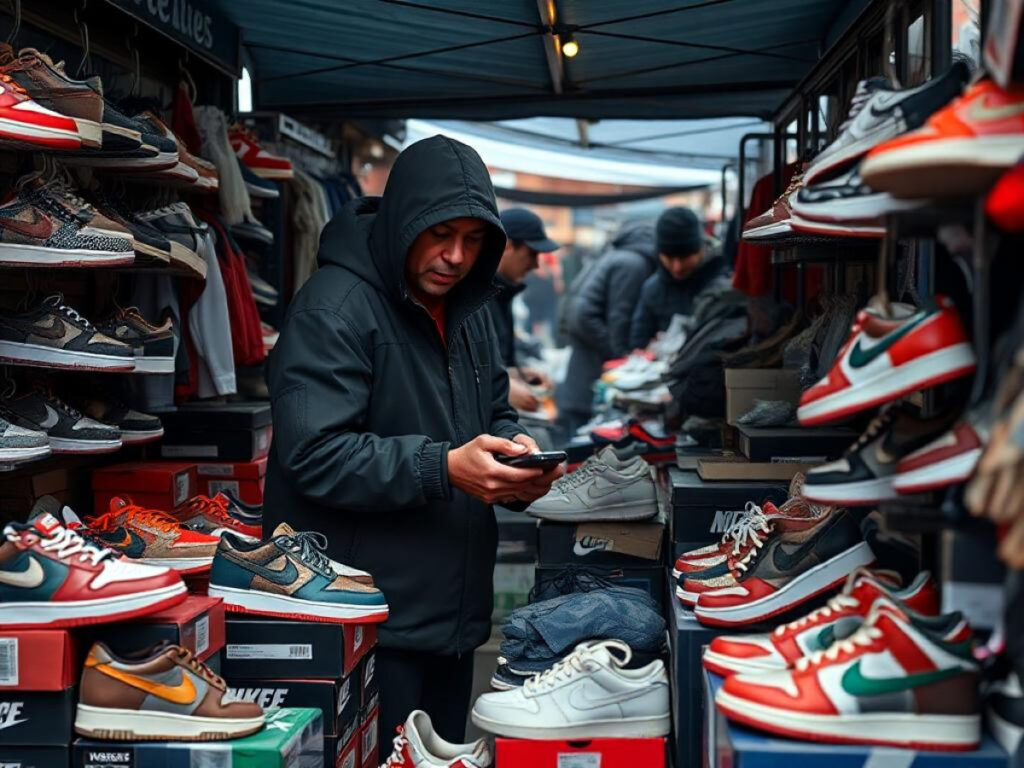
The counterfeit sneaker market is thriving. Of course, there are always the poor imitations at rock-bottom prices that pop up at the Saint-Ouen flea market in northern Paris. But now, the business is primarily growing online, driven by the trend of second-hand sites like Vinted, where authentication becomes nearly impossible.
In late April, global leader Nike won a legal battle against influencer Cedaz (over 1 million followers on social media), who was promoting counterfeit products. Last September, 27,000 fake pairs were seized at Saint-Ouen for a record value of 3.7 million euros.
The hunt for fake sneakers is in full swing, as shoes represent over 20% of counterfeit goods worldwide, according to the OECD. In this segment, sneakers, rare, desirable, collectible, and where brand plays a central role, are particularly sought after.
Original Materials
«The phenomenon has existed since the 1980s, through small networks of resellers, but has gradually structured itself,» traces sneaker expert Max Limol. Since 2017 and the release of the famous Triple S pair from Balenciaga, collaborations between the luxury and sportswear worlds have enhanced the appeal of counterfeiters to this market: for production costs under 4 euros, they can sell some models for over 1,000 euros. For Nike and the like, whose brand authenticity is their livelihood, the risk is enormous.
But where do these almost identical pairs come from? According to a May OECD report, 60% of counterfeit shoes are made in China, the epicenter of sportswear manufacturers’ subcontracting factories. Hong Kong and Turkey follow.
A former executive in charge of relations with Puma, Asics, and Fila within the highly secretive Taiwanese group Pou Chen, the world’s leading sneaker manufacturer, reveals the origin of these leaks: «Employees of a subcontracting factory can secretly smuggle out shoe components in their clothing or water bottle.» The pair can thus be assembled bit by bit outside the official factory… but with its original materials.
Second-hand Platforms
In these workshops, which often employ thousands of workers, it’s impossible to thoroughly search each employee every day or verify the reliability of their CV. For the workers, paid the bare minimum, this traffic is a tempting additional income. What countermeasures can brands implement? «Some pay private investigation firms, but the cost is high, and dismantling the entire network is a bottomless pit,» notes the expert.
Especially when, like Nike, you rely on 120 subcontracting factories in China. Faced with a «true ant work» in this secretive country – where small workshops can close or open in minutes –, brands often prefer «to be efficient and act directly with customs upon the product’s arrival,» explains Nadège Riederer-Lemarchand, an associate lawyer at Fidal and specialist in anti-counterfeiting. Francky Bendahan, a fashion and lifestyle consultant, adds: «Some brands also turn a blind eye because fakes contribute to visibility.»
Once the counterfeits arrive, they flood the black market, before mixing with authentic pairs on second-hand platforms (a market worth $6 billion). In the premises of his e-commerce site Second Step, Thomas Lerian has even erected a «wall of fakes,» where he stores the counterfeit shoes he has received.
«This pair, we bought it for 400 euros, but it’s fake: the leather is creased where it should be smooth,» he sighs. The leader in peer-to-peer sneaker resale, StockX, is not spared either. Paul Foley, head of brand protection for this e-retailer, acknowledges: «Last year, we returned the equivalent of $10 million in counterfeit shoes.»
Authentication Experts
In addition to this loss of revenue, platforms must invest to detect counterfeits. Because the question of their legal responsibility arises: in the coming weeks, a trial will open between Nike and StockX. The brand with the swoosh accuses the online platform of having sold fake pairs, whereas the latter systematically claims to authenticate them.
Resellers have had to create a job entirely their own: authentication experts. Almost all their senses are put to use. The sense of smell: «A counterfeit will smell like glue,» describes Mikhael Tordjman, founder of Limited Resell, a platform specializing in used sneakers. The sense of touch: «The materials, the stitching will not be the same,» continues the expert. The sense of sight: «Sometimes, the laces are too loose.» At the reseller Vestiaire Collective, an internal training school has been established, where brands conduct some courses.
These brands regularly quiz their resellers about the most counterfeited models, and even ask to have them delivered. «We help the equipment manufacturers because they struggle to get their hands on them, details a reseller. They want to analyze them and seek to understand their origin and the importance of the flows.»
The counterfeits can even inspire them. «In February 2026, the Air Jordan 6 Reverse Infrared will be released, tells Max Limol. It’s black with red accents, and has long existed but only as a counterfeit pair! It eventually made its way into the imagination, until Nike decided to claim it.» Sometimes, it’s the brands that mimic the counterfeits.
Resellers and Manufacturers Reduce Stride
It’s not just the counterfeits causing pain to the collectible sneaker resale sites. The speculative bubble around this $6 billion market is also deflating. «For years, sneakers played a role in fashion as a status symbol, explains consultant Francky Bendahan, an expert on the subject. The pair you wore told the community you belonged to. But there’s been a slowdown over the past twelve to eighteen months.»
A lack of strong new releases in the market coupled with the purchasing power crisis has slowed the bidding war around the rarest pairs, priced in the thousands of euros. As for the manufacturers – starting with the leader Nike –, they are rationalizing their range in a gloomy context, instead of flooding consumers with new products. As a result, many young startups that bet on this lucrative market have faced severe difficulties (Sneakersnstuff, WeTheNew…), or have even been liquidated (Kikikickz, Restocks…). A silver lining in these gray skies: the running shoe remains in great shape. Gone are the glitter of Fashion Week and ultra-limited editions, the sneaker is back on asphalt and dirt trails.