The ash dieback disease is advancing through northeastern France, killing thousands of trees. This incurable fungal illness is also disrupting the routines of farmers and local authorities who must act to prevent trees from falling.
Châtillon-sur-Seine (Côte-d’Or), on the ground
“When you start seeing ash dieback, you’ll notice it everywhere,” warns Damien Dondaine. For about ten years, this river technician at the public water management authority Epage Sequana in Châtillon-sur-Seine, Côte-d’Or, has been monitoring the devastation caused by the fungus that attacks ash trees. Looking up at the crowns of these trees, normally robust, you can quickly pick out bare twigs and branches protruding. In younger, recently infected trees you might only see three or four naked shoots. In the worst cases, nearly all the foliage is gone. Some trees are split and half-dead, with limbs already broken.
Why a Simple Mistake in Your Online Pension Application Could Cost You Your Retirement Benefits
The ultimate trick to banish mold from your bathroom grout in just 7 minutes—no vinegar or baking soda needed
The scene is bleak: in Côte-d’Or ash trees provide shade for livestock, stabilize and line riverbanks, fill the forests and give character to footpaths and village squares. Dondaine picks up a very large fallen branch. “It weighs almost nothing, it’s completely dry,” he says, then presses a finger into the broken trunk as if into soft butter, leaving a clear mark. “Have you ever seen a stump crumble like that?” he asks.
Ash dieback was first identified in France in 2008 in the Haute-Saône. Five years later the problem had spread to the whole department of Aube. The invasive pathogen, originating from Asia, is carried by the fungus Chalara fraxinea and travels on the wind. “Its spores can travel about 60 km per year,” explains epidemiologist Benoît Marçais, who studies tree–microbe interactions at Inrae and the University of Lorraine. “The fungus settles and germinates in the leaves, then progresses into the shoots.”
Experts describe wilting leaves, dieback of branches, and then death of branches and sometimes the whole tree. “Almost every tree is affected; only about 3% show resistance,” he adds.
This disease is one of the factors behind the poor condition of many woodlands, say the National Forestry Office (ONF) and the National Institute of Geographic and Forest Information (IGN), alongside climate warming and the spruce bark beetle crisis. The number of dead trees keeps rising. Nationwide tree mortality has climbed sharply over the past decade, and ash mortality in particular has increased roughly fivefold.
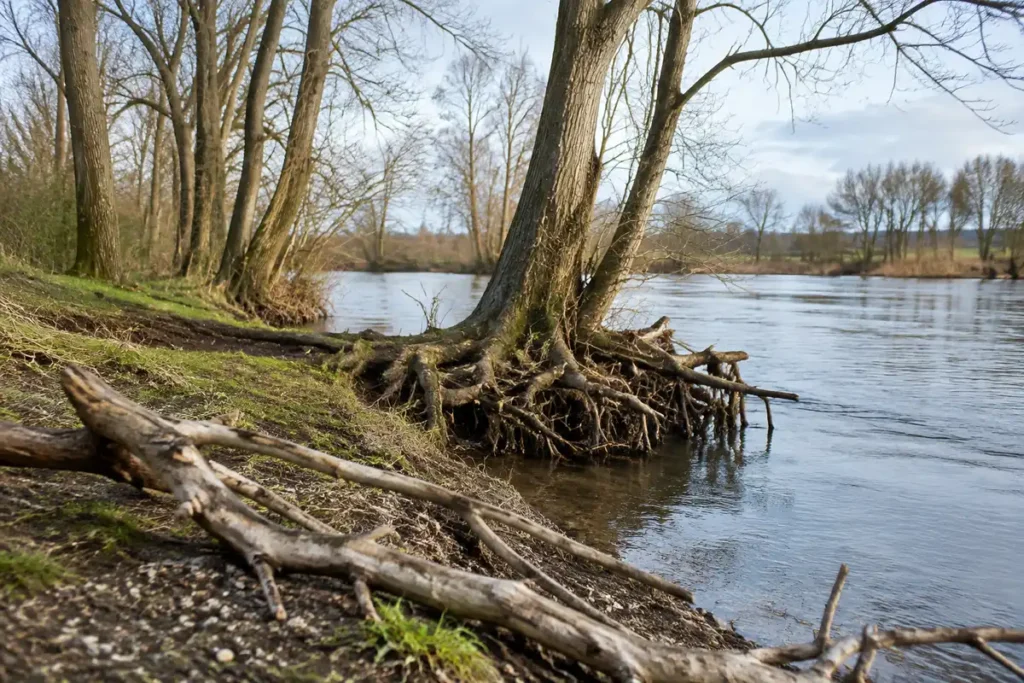
At a riverside hollow, Dondaine examines the collar zone—the transition between trunk and root system—of two adjacent trees. A fifty-year-old alder shows a dense mat of intertwined roots submerged in cool, shaded water. Beside it, the base of a nearby ash has only a small clump of very short, dry roots. The fine rootlets that anchor the tree and take up nutrients are gone. Dehydrated and rootless, the ash’s stability is compromised; a strong gust could bring it down.
Beneath the alder’s tangle of roots fish and crayfish find shelter. The ash’s roots don’t even reach the water. “Rootlets also play a role in self-purification,” the technician points out. “They capture nutrients flowing from the catchment,” including pesticides and nitrogen-based products washed out from adjacent fields. At the foot of the ash, by contrast, runoff passes unfiltered. Vegetation along riverbanks also has a landscape function, provides habitat for birds and can produce berries and firewood.
In this region ash lines roads and rivers—long ribbons of trees along the Seine, the Laignes and the Ource. “Where your riverbanks are almost entirely ash, things will be strange,” Dondaine continues. “No bank stabilization, no shade, lots of woody jams…” When ash trees fall they can rip banks apart. Over time the fallen wood accumulates in the water, drifts, and then gets lodged against structures.
On the upper Seine basin, Dondaine has identified more than a hundred bridges and similar numbers of hydraulic works where uprooted trees are likely to become trapped. These piles of timber also retain water and raise flood risk in an area already vulnerable.
For the last two years Epage has stopped carrying out vegetation maintenance along waterways. “Up until the 2000s, river maintenance was funded by water agencies to the tune of 80%. Until 2024, financing still covered roughly 40%,” he explains.
That funding was cut, and now landowners or municipalities must pay the full bill. Costs can be steep, especially when a single farmer owns several kilometers of streamside and dozens of trees. The same goes for many small, sparsely populated communes with limited budgets. On the watershed where Epage Sequana works, “there are 162 communes for 28,000 inhabitants,” Dondaine notes.
About thirty kilometers from Châtillon-sur-Seine the town of Les Riceys has been proactive. Crossed by the Laignes, it ordered an inventory of dead or fallen trees along the river and notified each owner. The count was stark: on that commune alone 150 ash trees were down and many more standing dead. Similar situations can be found elsewhere: the city of Nancy in Meurthe-et-Moselle had to take measures for nearly six months because of the disease, and Nogent-sur-Seine in Aube temporarily closed a playground after around twenty hazardous trees threatened visitors.
With departmental and municipal budgets under pressure, Anthony Delauné, an arborist who runs the company Arbres et branches in the neighboring Nièvre, advocates for smart management plans. “Sometimes it’s better to designate safety zones rather than cut down 50 ash trees that will fall at the next strong wind anyway,” he says.
There are exceptions for riverbank work that can reduce costs: vegetation maintenance may be financed as part of restoration projects. At Vix in Côte-d’Or, Epage Sequana has been completing the restoration of a spring feeding the Seine, reshaping the riverbanks. Diseased trees were felled and a greater diversity of species encouraged. Technicians even strung long ribbons to deter cormorants from preying on trout during spawning. Local angling associations also help secure banks when owners grant them access rights.
Like many fungi, Chalara fraxinea favors moist environments where it thrives and windy locations that aid its spread. As a result, northern France and the United Kingdom are also affected. In parts of Hauts-de-France where ash makes up around 40% of tree species, the disease is advancing rapidly.
In 2017 the ONF launched operations in forest areas hit hard by the disease—places such as Boulogne, Desvres, Hardelot, Vimy and Nieppe. It took almost a year to secure access before reopening those sites. Full restoration will require long-term work: an estimated twenty years and a budget of roughly 20 million euros.
Ash pollards are also being eaten away by the disease. The pollarded ash, an emblematic tree of the Marais Poitevin, faces a grim future with about 400,000 trees at risk. Local action plans and coordination efforts have been set up to try to halt the steady deterioration of this protected natural area.
Fighting ash dieback is expensive. In Britain the fungus is estimated to cost more than £550 million (over €650 million) each year—far more than the roughly £200 million annually attributed to Japanese knotweed, an invasive plant that disrupts ecosystems.
Fortunately, a small proportion of ash trees display resistance. But it will take many decades before resistant individuals regain dominance. “The main challenge is to support those trees,” says Benoît Marçais. Efforts must also focus on reducing the density of infected ash to slow contagion within stands and, of course, on promoting biodiversity.
Similar Posts
- The surprising reason gardeners swear by painting tree trunks white
- Celebrating the “Tree of the Year”: Meanwhile, Our Forests Are Being Carved Up
- Beavers Boost CO₂ Storage Tenfold in Wetlands: Nature’s Engineers Combat Climate Change
- Every Tree a Monument: Discover the Majestic Life of Trees When Unfettered
- Drought Crisis: A Quarter of France’s Small Rivers Have Dried Up

Hi, I’m Ashley from the Decatur Metro team. I share essential information for a sustainable and responsible lifestyle.